


Applied Digital grew revenue 407 percent, signed three new hyperscaler leases worth roughly $20 billion, and still lost $110.6 million on a GAAP basis. Two thirds of the revenue is not worth owning. The third that is tells you almost everything about what the equity is worth.
Section One
The print, and why the tape shrugged
The release moved the stock 3 percent. The conference call moved it another 3 percent. The sequence is the story.
Applied Digital reported fiscal fourth quarter revenue of $258.7 million against a consensus that sat somewhere between $82 million and $95 million depending on which aggregator you trust. Adjusted earnings came in at four cents per share against estimates that ranged from a loss of nineteen cents to a loss of twenty eight cents. On any conventional reading, this was one of the largest revenue beats of the current earnings season.
The stock had closed the regular session at $26.38, down 3.00 percent, its third consecutive down day. It traded up to roughly $27.24 within twenty minutes of the release, then kept climbing through the five o’clock conference call to $27.86, a gain of about 6 percent. Options had been pricing an implied move of somewhere between 12 and 14 percent depending on whose calculation you use.
The sequence matters more than the level. Roughly half the move came on the written release and the other half came during the call. That split tells you the release was not where the news was. The three leases that define this quarter had each been announced separately in June and July as they were signed, so by the time the wire crossed at 4:05pm, the $20 billion was already old information. Investors had also largely stopped treating the income statement as informative, which is a defensible position for a company whose reported revenue can quintuple because of an accounting policy on construction billing.
What was new arrived on the call. Management said it now expects to reach a $1 billion annual Net Operating Income run rate within one year, three years ahead of the five year target it set twelve months ago. It described visibility to more than 5 gigawatts of critical IT load across existing campuses through 2032. And it guided to roughly $600 million of capital expenditure in the current quarter alone, rising from there as more campuses enter advanced construction.
Hold onto that $1 billion figure. It is a testable claim, and testing it against the megawatt arithmetic is the single most useful thing an outside investor can do with this release.
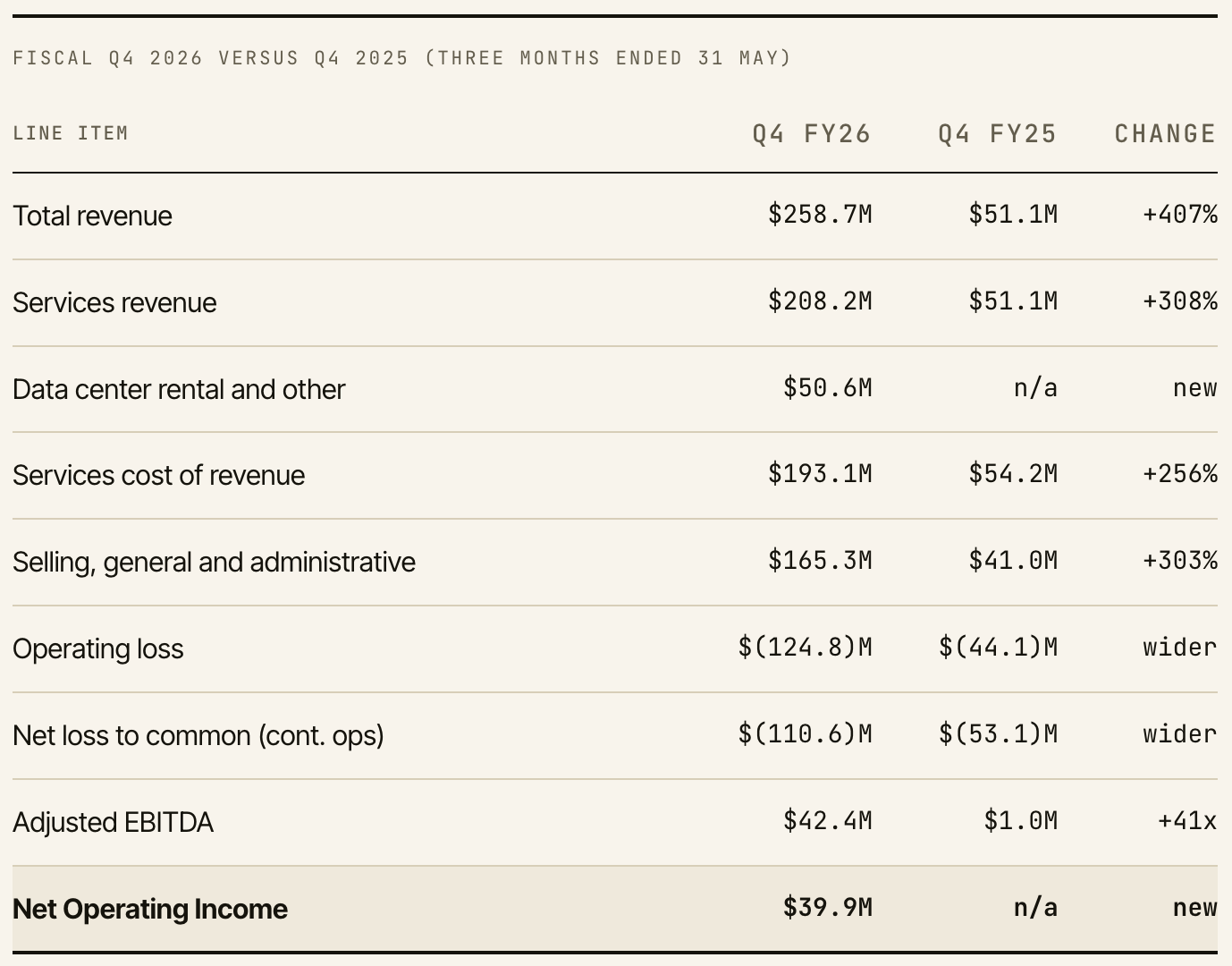
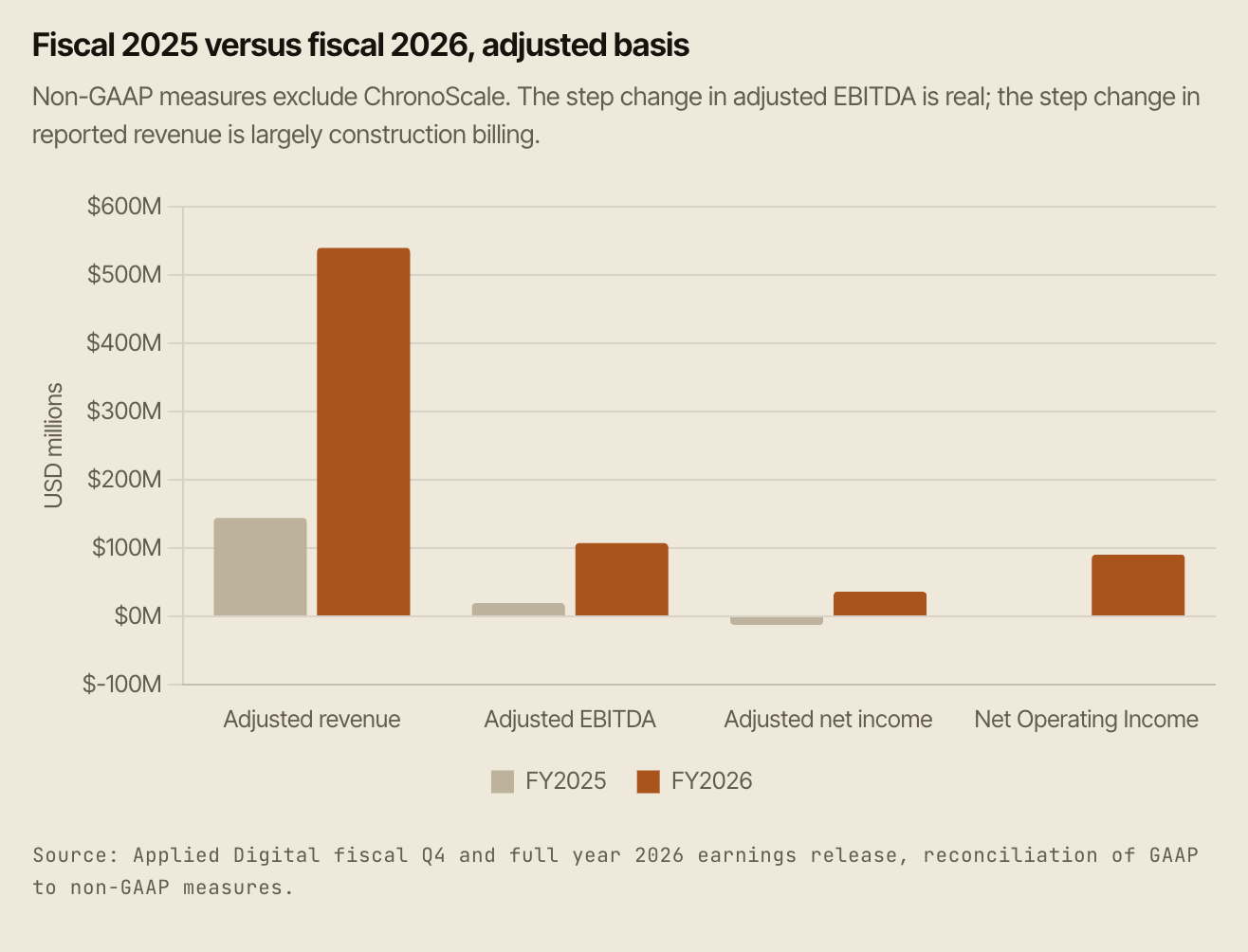
Note the shape of that table. Revenue grew 407 percent. Operating loss almost tripled. Adjusted EBITDA went from essentially nothing to $42.4 million, which is actually slightly below the $44.1 million posted in the December to February quarter. A company can only produce that combination if the incremental revenue carries almost no margin, and if the cost base is expanding faster than the revenue that will eventually pay for it. Both are true here, for reasons that turn out to be more benign than they look.
Section Two
Where the revenue actually came from
Fifty nine percent of the quarter was construction billing at a four percent margin.
Applied Digital’s HPC Hosting segment produced $203.0 million of the quarter’s $258.7 million. Management broke it into three parts, and the breakdown is the single most useful disclosure in the release.
Base rent was $44.1 million. Tenant recoveries, which are reimbursements passed straight through to the landlord, were $6.5 million. Tenant fit-out services were $152.4 million. That last number is the company billing its tenant for building out the interior of the data center to the tenant’s specification, and it is booked as revenue because Applied Digital acts as principal on the work.
The margin on it is close to nothing. Services cost of revenue rose $145.6 million on fit-out work against $152.4 million of fit-out revenue, which implies a gross margin of roughly four and a half percent. This is contractor economics, not landlord economics. It is real cash and it is not fraudulent in any sense, but it is a construction pass-through that will disappear the moment the buildings are finished.
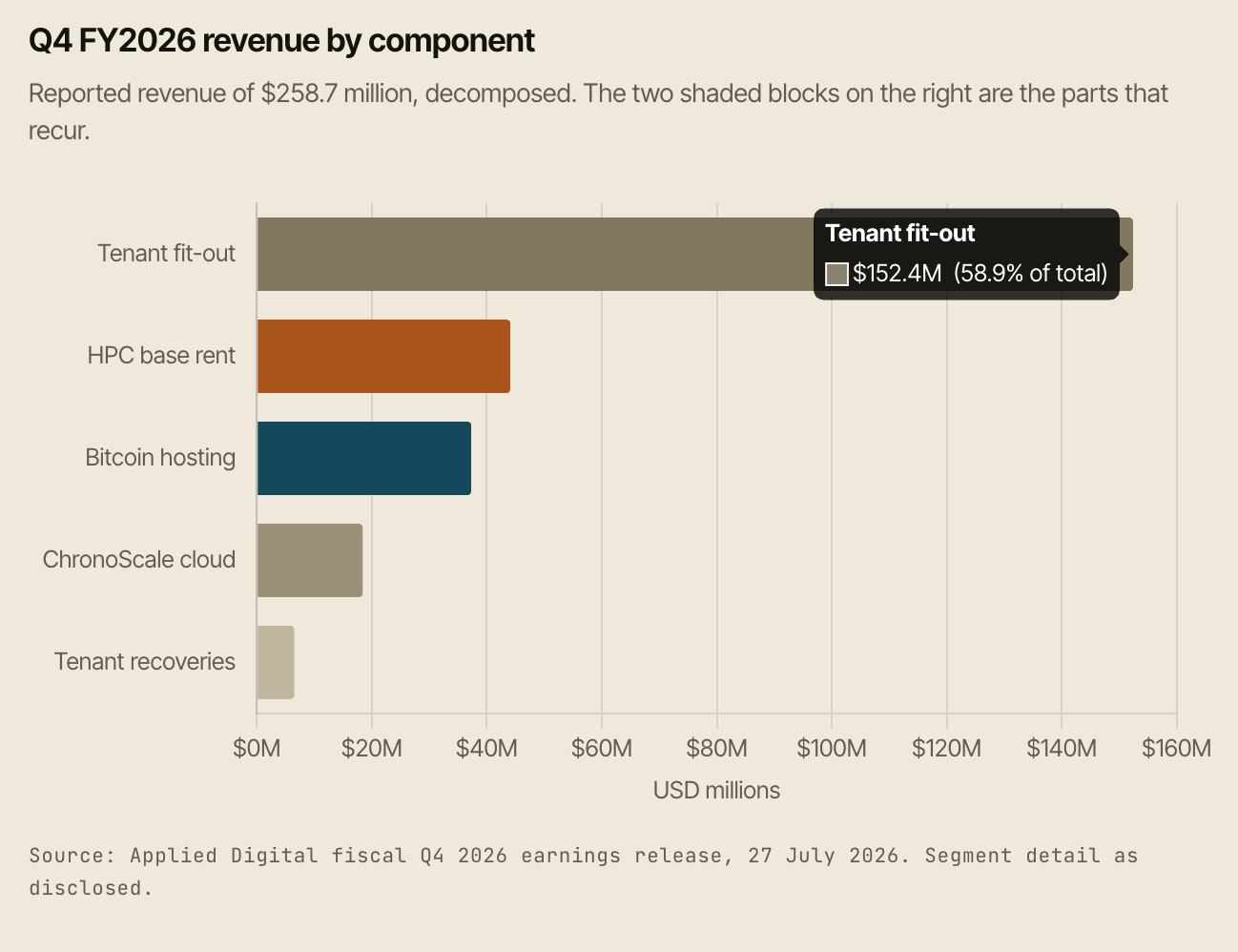
Strip out fit-out and recoveries and the picture changes completely. What is left is $44.1 million of HPC base rent plus $37.3 million from the bitcoin hosting business plus $18.4 million from ChronoScale, the newly separated cloud entity that Applied Digital still consolidates at 96 percent ownership. That is $99.8 million against $51.1 million in the year ago quarter.
The number to remember
Underlying revenue growth was 95 percent, not 407 percent. The recurring, high margin core, meaning HPC base rent plus bitcoin hosting, was $81.4 million, or 31 percent of reported revenue.
That is still a very good number. Ninety five percent growth on a base that was already growing is not a disappointment. But it is a different company than the one implied by a 407 percent headline, and the distinction matters enormously for anyone building a forward model. If you extrapolate reported revenue, you are extrapolating a construction schedule. If you extrapolate base rent, you are extrapolating a lease book.
The rent line is the one that compounds
Net Operating Income, which the company defines as HPC base rental revenue less property operating expenses, property taxes and insurance, was $39.911 million on $44.062 million of base rent. That is a 90.6 percent NOI margin, which the company rounds to 91 percent in its own reconciliation. Base rent was also $44.1 million in the prior quarter, when the same single building was live, which is a useful confirmation that the rent stream is a flat contractual amount rather than a usage-linked one. For context, a well run US industrial REIT operates in the high 60s to mid 70s. Triple net leased infrastructure with the tenant carrying opex runs higher, and Applied Digital’s structure is closer to that model.
The bitcoin hosting business, which most of the sell side treats as a legacy embarrassment, generated $12.5 million of segment operating profit in the quarter on $113.8 million of segment assets. Annualized that is a 44 percent return on assets. Chief executive Wes Cummins made the point directly on the release, noting the business is paid on capacity provided rather than on the bitcoin price. At 286 megawatts across Jamestown and Ellendale it is small relative to what is coming, but it is the only part of the company currently throwing off unencumbered cash.
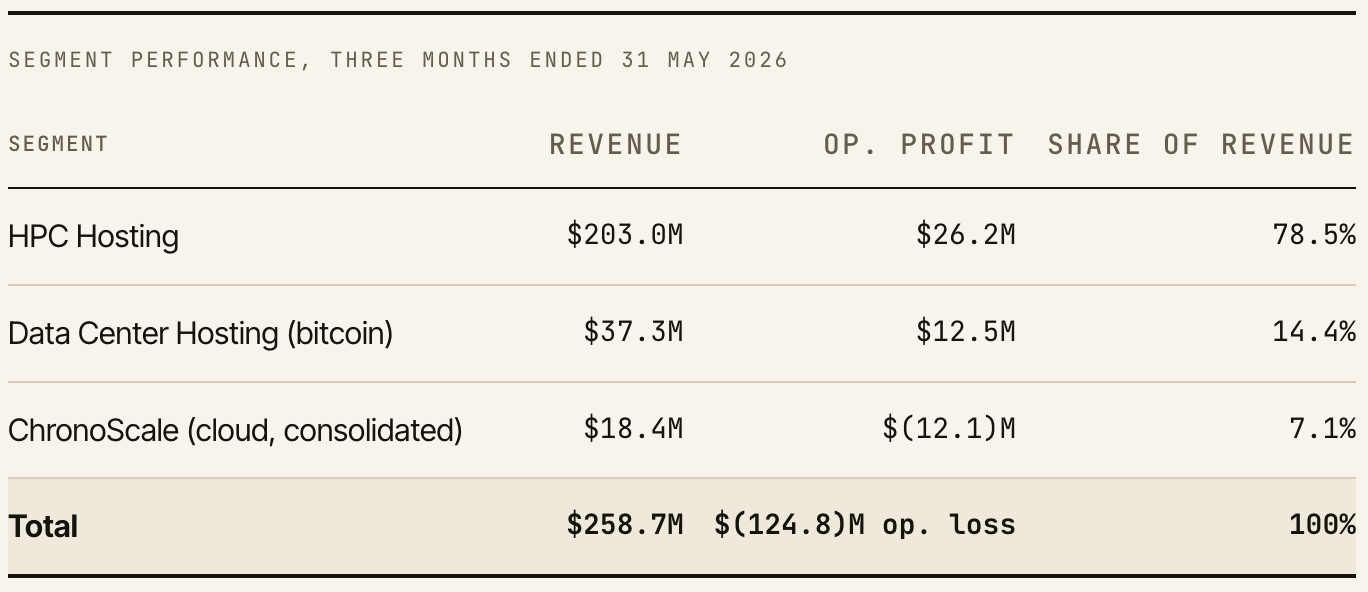
The gap between $38.7 million of positive segment profit and a $124.8 million consolidated operating loss is almost entirely corporate overhead, and almost all of that is stock compensation. We will come to it.
Section Three
The balance sheet became a project finance vehicle
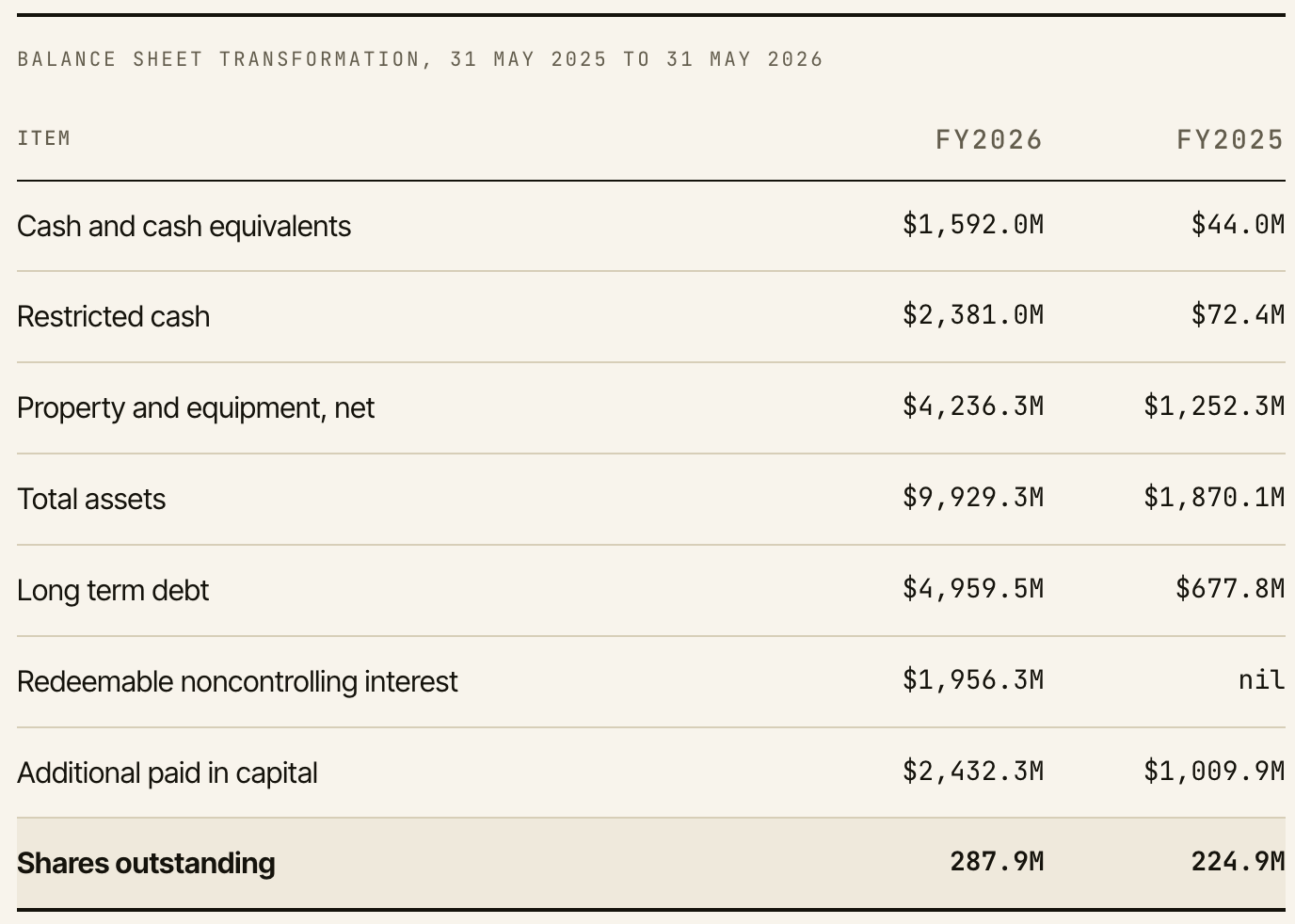
Total assets went from $1.87 billion to $9.93 billion in twelve months. That is the actual event.
In the fiscal year just ended, Applied Digital raised $6.88 billion of financing, spent $2.87 billion on property and equipment, and paid $263.4 million of cash interest. Operating cash flow was $89.7 million. The ratio of capital expenditure to operating cash flow was 32 to 1.
This is no longer a technology company that happens to own buildings. It is a development platform that raises capital in tranches against signed leases and converts it into energized megawatts. Judged as a technology company its financials are alarming. Judged as a project developer they are ordinary, and in some places better than ordinary.
Three things buried in those numbers
First, most of the cash is spoken for. Of the $3.97 billion of cash and restricted cash on the face of the balance sheet, $2.38 billion is restricted, held in construction escrow against the secured notes. Unrestricted cash is $1.59 billion. Management cites $4.2 billion, which reconciles to the $4.15 billion at the foot of the cash flow statement and implies roughly $180 million of further restricted cash classified outside current assets. Both figures are accurate. The free and clear number is still $1.59 billion.
Second, cash interest is running nine times the income statement figure. Net interest expense in the P&L was $29.5 million for the year. Cash interest paid was $263.4 million. The difference is capitalized construction period interest, which is correct accounting and also means the income statement materially understates the current carrying cost of the capital structure. When the buildings go into service, that interest starts landing in the P&L.
Third, stock compensation is now the largest single expense line that nobody talks about. Full year stock based compensation was $219.3 million, against $22.5 million a year earlier. In the fourth quarter alone it was $127.8 million, driven by accelerated vesting tied to the ChronoScale separation. Measured against adjusted revenue of $240.4 million, fourth quarter stock compensation was 53 percent of the top line.
Adjusted net income of $12.9 million exists because $127.8 million of stock compensation was added back. That is not a technicality. It is the entire gap between profitable and not.
None of this makes the adjusted figures illegitimate. Excluding stock compensation is standard practice, the ChronoScale acceleration genuinely was a one time event, and a reader who understands the adjustment is not being misled. But an investor who reads “adjusted net income of $36.1 million for the year” and stops there has learned very little about the cash economics of the business.
The redeemable noncontrolling interest deserves its own paragraph
Sitting in temporary equity, between liabilities and shareholders’ equity, is $1.96 billion of redeemable noncontrolling interest, created by $1.83 billion of contributions during the year. This is institutional capital that participates in the project entities. It is not common equity and it is not debt. It originates in a preferred equity facility with Macquarie Asset Management sized at up to $5 billion, and the noncontrolling interests together absorbed $59.7 million of losses during the year, which flatters the loss attributable to common holders.
Any valuation that nets debt against cash and stops there will overstate the equity value by roughly $6.80 per share. We treat it as a claim ahead of common in everything that follows.
Section Four
The megawatt ledger: cost, rent, and spread
Every argument about this company eventually reduces to one calculation.
