
AstraZeneca: The Patent Cliff Has Arrived. The Pipeline Must Now Prove Itself.

Q2 earnings beat expectations, but the real investment case rests on whether oncology, respiratory, rare disease, and a new obesity franchise can carry revenue to $80 billion by 2030.
straZeneca reported the kind of quarter that reassures investors without fully resolving their concerns. Revenue kept growing, core earnings beat expectations, oncology remained powerful, and management reaffirmed its $80 billion revenue ambition for 2030. Yet the results also showed why the stock has become more difficult to value. Legacy drugs are declining quickly, China is under pressure, cash conversion weakened, and several pipeline setbacks have reminded investors that scientific diversification does not eliminate scientific risk.
The market responded positively. AstraZeneca shares rose about 1.7% in London after the release, even though the stock remained down for the year following the failed Wainua cardiovascular trial earlier in July.4 The relief makes sense. Q2 core earnings per share reached $2.63, up 18% at constant currency and ahead of the company compiled consensus of $2.48. Revenue was almost exactly in line with expectations at $15.38 billion.1
The LongYield thesis
AstraZeneca is no longer a simple earnings growth story. It is a portfolio transition story. The current business is strong enough to absorb a meaningful patent cliff, but the next stage of value creation depends on a large number of clinical readouts, several new launches, and continued above average execution. At roughly 16.7 times estimated 2026 core earnings, the stock is reasonably valued, not obviously cheap.
Section 1 The Quarter Was Better Than the Headline Revenue Number
At first glance, Q2 looked merely solid. Total revenue increased 5% at constant currency to $15.38 billion. That is not an extraordinary growth rate for a company still presenting itself as one of global pharma’s premier growth platforms. The more important number was underneath the surface: first half revenue grew 11% when Farxiga and Brilinta, two products already affected by generic competition, were excluded.
This distinction matters. AstraZeneca is already experiencing the erosion that many pharmaceutical companies spend years warning investors about. Farxiga, Brilinta, and roxadustat are not theoretical future headwinds. They are declining now. The question is whether the rest of the portfolio is growing fast enough to compensate.
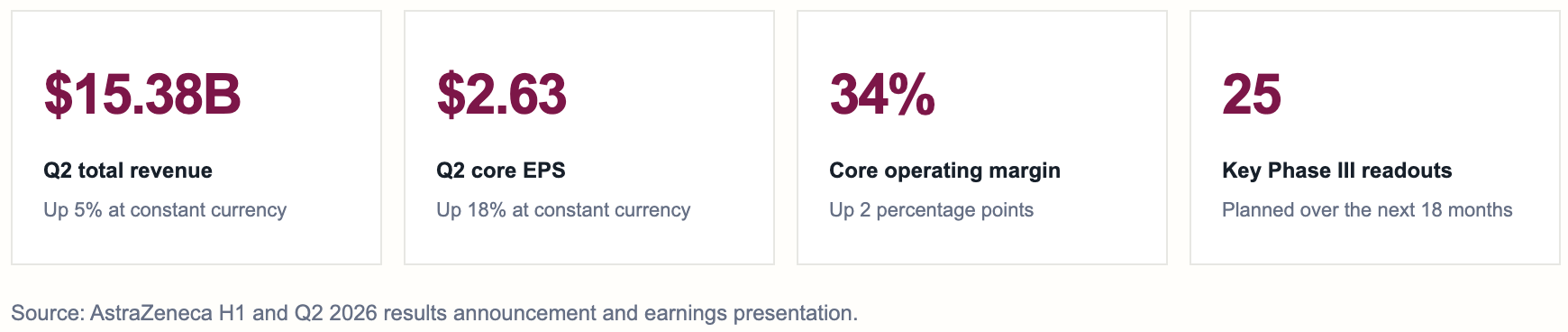
The earnings beat was real, but its quality deserves a closer look. Core operating profit increased 10% at constant currency, while core EPS rose 18%. The difference was partly explained by a lower tax rate. AstraZeneca’s Q2 core tax rate fell to 15%, six percentage points below the prior year, helped by a one time adjustment to deferred tax assets after internal legal entity changes.1
That does not make the quarter weak. Gross margin improved by one percentage point to 84%, and operating leverage remained healthy despite heavy investment. It does mean investors should not simply annualize the 18% EPS growth rate. The underlying operating business grew closer to 10%, which is still respectable and consistent with the company’s full year guidance.
The cleanest way to read Q2: revenue growth was moderate, operating growth was strong, and the final EPS result received an additional benefit from tax.
Management kept its 2026 outlook unchanged. Total revenue is expected to rise by a mid to high single digit percentage at constant currency, while core EPS is expected to increase by a low double digit percentage. Foreign exchange could add a low single digit benefit to reported revenue if June currency rates persist through the second half.1
Section 2 Oncology Is Carrying the Company, and It Is Getting Broader
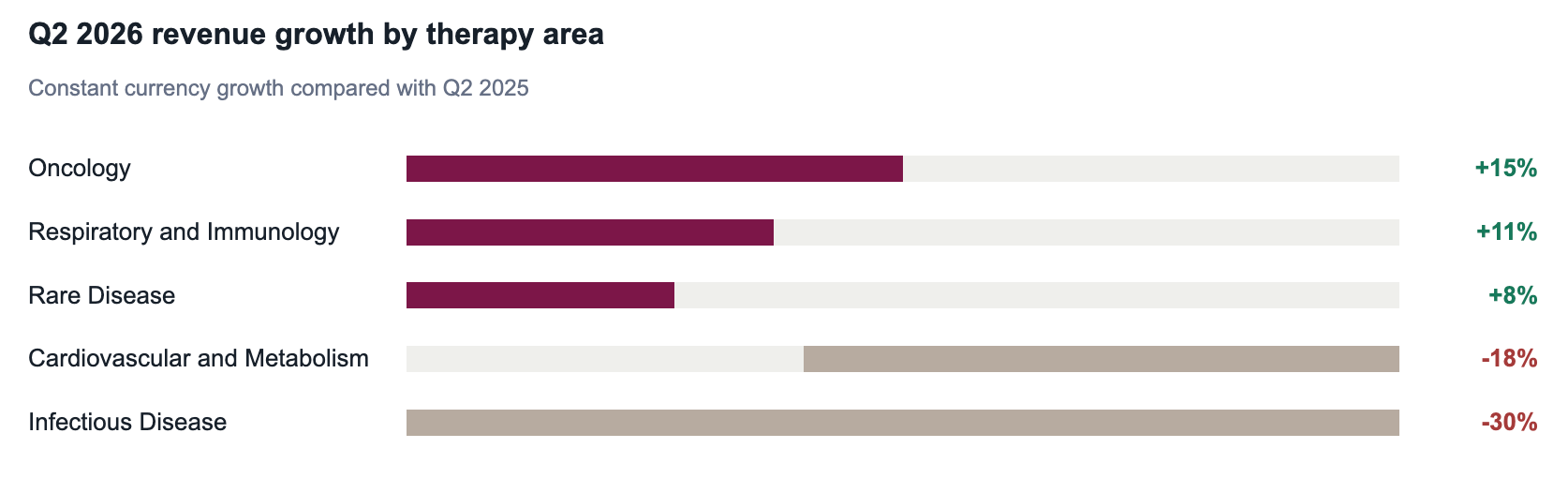
AstraZeneca generated 48% of Q2 revenue from oncology. The division grew 15% at constant currency to $7.33 billion, a pace that would be attractive even for a much smaller biotechnology company. More importantly, the growth did not come from one drug.
Tagrisso remained the largest individual medicine, with Q2 revenue of $1.94 billion and 6% constant currency growth. That pace is slower than AstraZeneca’s newer oncology products, but the franchise still matters because Tagrisso is the backbone of the company’s position in EGFR mutated lung cancer. Management said the FLAURA2 combination regimen held around three quarters of the growing first line combination segment in the United States.3
Imfinzi was the standout large asset. Revenue increased 27% to $1.85 billion, driven by lung cancer, gastric cancer, and newer bladder cancer settings. Calquence crossed $1 billion in quarterly revenue for the first time, up 16%. Enhertu rose 31% to $888 million, supported by continued leadership in HER2 positive and HER2 low breast cancer. Truqap grew 37%, while Datroway remained small but expanded more than fivefold
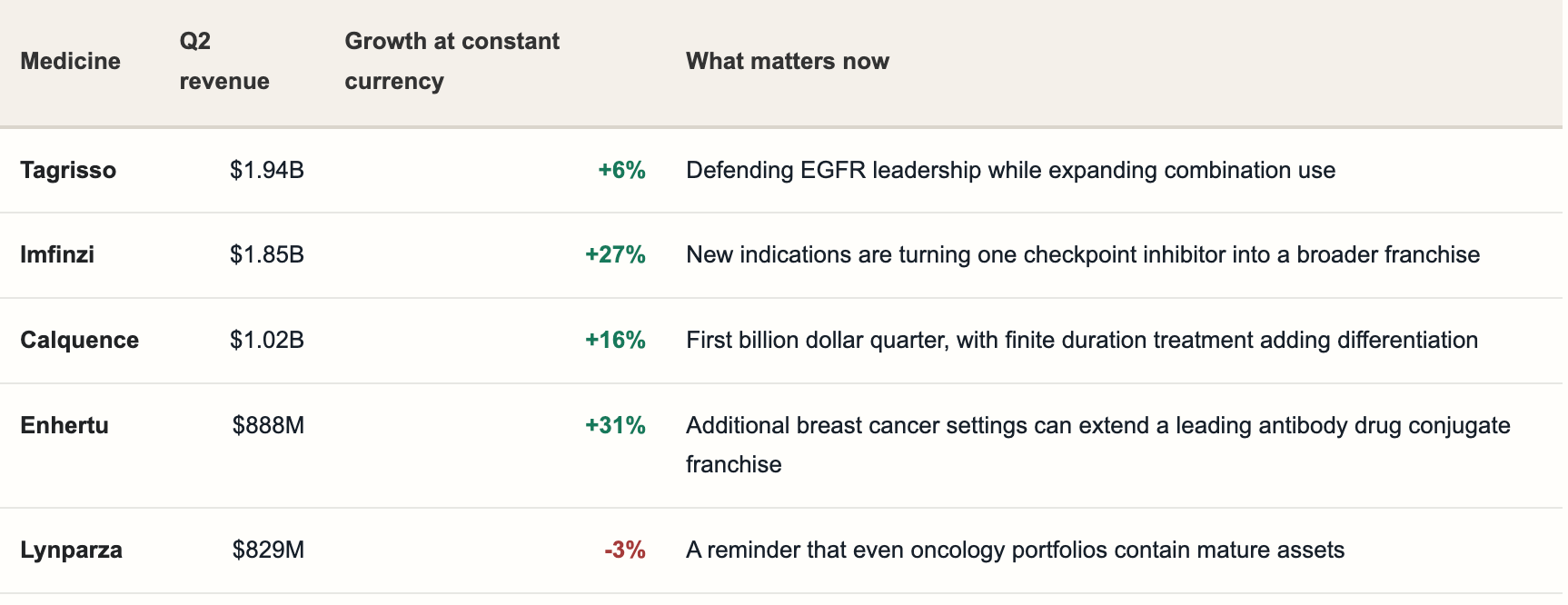
The strategic advantage is breadth. AstraZeneca has multiple oncology assets approaching or exceeding billion dollar quarterly scale, plus a second layer of smaller medicines growing quickly. That reduces dependence on any one readout. It also creates combination opportunities, which can extend product lives and reinforce the company’s position across entire treatment pathways.
There is a financial nuance. Enhertu and several other partnered medicines generate alliance revenue or require profit sharing. Alliance revenue increased 33% at constant currency in Q2, which is excellent for growth but can pressure gross margin compared with fully owned products. This is one reason management is emphasizing wholly owned antibody drug conjugates such as sonesitatug vedotin.
Section 3The Patent Cliff Is No Longer a Future Risk
AstraZeneca’s BioPharmaceuticals division declined 7% at constant currency in Q2. Within it, Cardiovascular, Renal and Metabolism revenue fell 18%. Farxiga dropped 19% globally to $1.80 billion, Brilinta declined 63%, and roxadustat fell 82%.1
Those declines explain why reported company growth looks much slower than the momentum in oncology and respiratory. Farxiga alone still represented 12% of Q2 revenue. Even after a sharp decline, it remained one of the company’s largest products. AstraZeneca therefore needs billions of dollars in new revenue simply to keep the consolidated growth rate in the mid to high single digits.
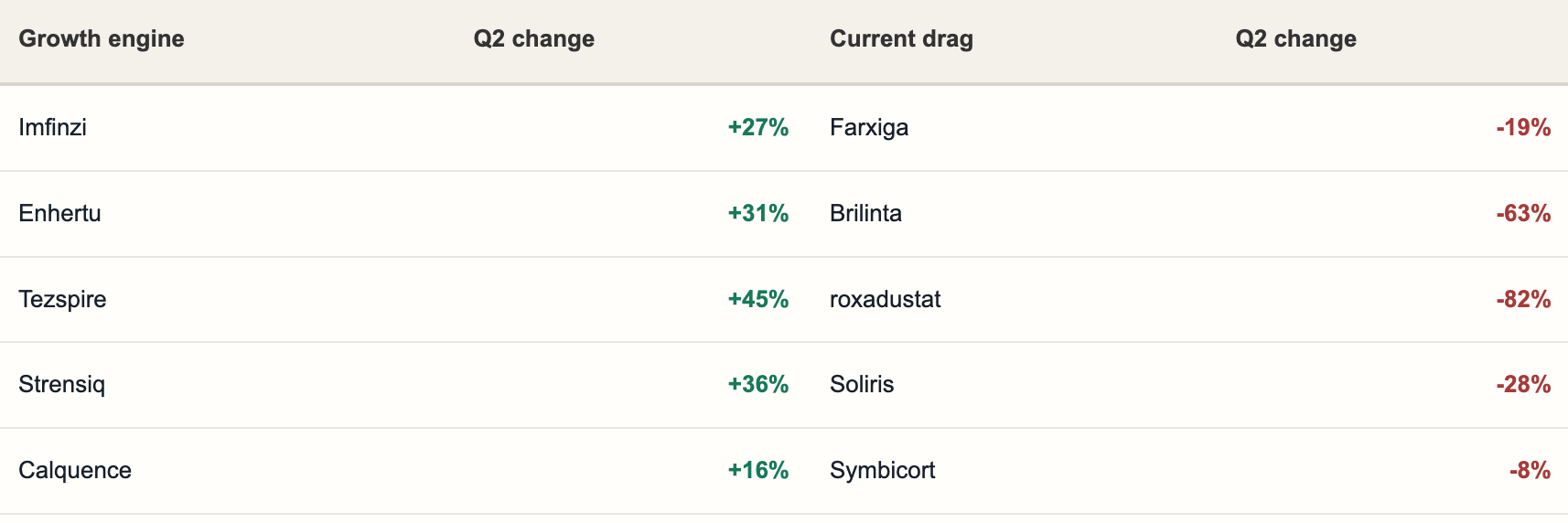
The encouraging part is that the replacement engine is already visible. Respiratory and Immunology grew 11% in Q2. Tezspire increased 45%, Breztri rose 20%, Fasenra grew 13%, and Saphnelo increased 24%. Rare Disease grew 8%, led by 36% growth from Strensiq and 12% growth from Ultomiris.1
The less encouraging part is that replacement growth is expensive. AstraZeneca spent $3.66 billion on core research and development in Q2, equal to 24% of revenue. Core selling, general and administrative expense reached $4.05 billion, or 26% of revenue, as the company supported current launches and prepared for future ones. Those investments are necessary, but they create a high execution burden. New products must succeed clinically, receive reimbursement, and scale commercially before the older products decline too far.
AstraZeneca does not need every pipeline asset to work. It does need enough of them to work before the current portfolio loses too much altitude.
