
Capitol Gains
The Complete Congressional Stock Trading Report 2026

Every member of Congress is legally required to disclose stock trades within 45 days. Academics have found Senators historically beat the market by 12% annually, House members by 6%. They sit on the committees that regulate the companies they own. This report tracks every significant disclosed trade — who's buying, who's selling, and what they know that you don't.

The Legal Framework
The STOCK Act: What the Law Requires — and Doesn’t
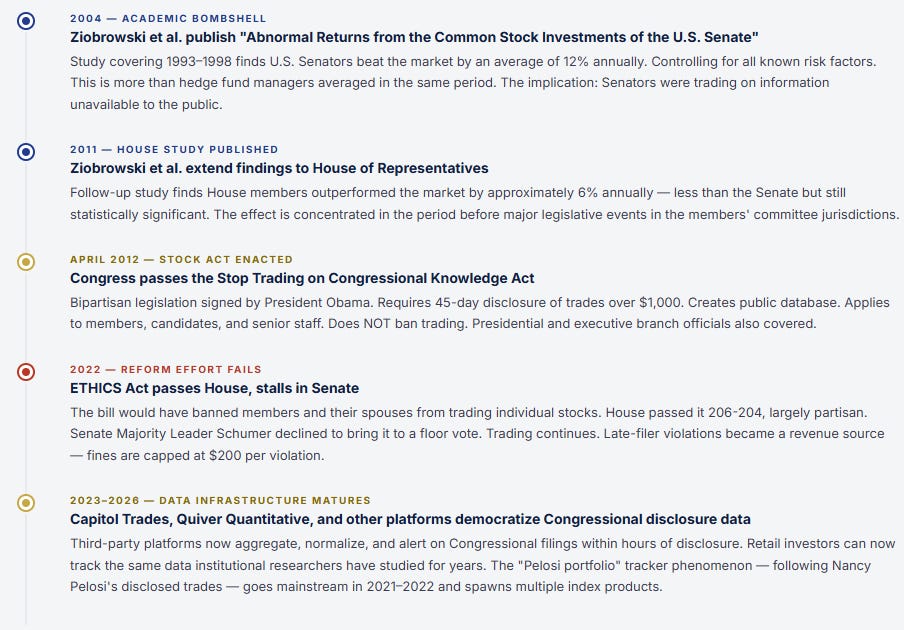
The Stop Trading on Congressional Knowledge Act — the STOCK Act — was signed into law in April 2012 after years of investigative journalism and academic research demonstrated that members of Congress were systematically beating the stock market by margins inconsistent with luck. The law requires every member of Congress and their senior staff to disclose any stock, bond, commodity, or options transaction over $1,000 within 45 days of the transaction. The disclosures are public, searchable, and filed online with the House Clerk or Senate Secretary.
What the STOCK Act does not do is equally important. It does not prohibit members of Congress from trading individual stocks. It does not require them to use blind trusts. It does not restrict them from buying or selling securities in companies regulated by the exact committees on which they serve. The disclosure requirement was the limit of what Congress was willing to impose on itself. A bipartisan push in 2022 to ban Congressional stock trading entirely — the ETHICS Act — passed the House but died in the Senate. As of early 2026, there is no ban. Members are free to trade. They just have to tell you about it.
🏛 The Structural Conflict That Makes This Signal Real
Members of Congress serve on committees that directly regulate industries, approve defense contracts, set healthcare reimbursement rates, craft semiconductor subsidy packages, and determine energy policy. A member on the Senate Armed Services Committee knows which defense programs are about to be funded before the budget is public. A member on the House Financial Services Committee hears private briefings from bank regulators before rate decisions. The STOCK Act requires them to disclose what they traded. It does not stop them from using what they heard to trade it.
Academic Signal
What the Research Actually Shows About Congressional Returns
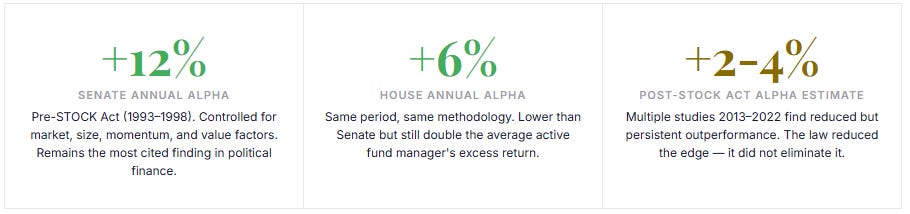
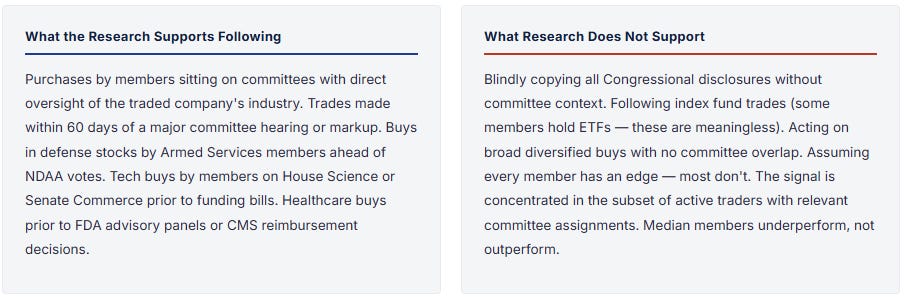
The post-STOCK Act literature is nuanced. Several studies found that the alpha compressed significantly after 2012 — the threat of public scrutiny alone appears to have changed some behavior. However, two patterns remain robust. First, purchases made shortly before a member’s committee takes legislative action in a related sector still generate abnormal returns. Second, the outperformance is concentrated in a small number of active traders, not the median member (many of whom hold index funds or have no disclosed trades at all).
A 2023 study by Karadas (Journal of Financial Markets) found that committee assignments remain a stronger predictor of Congressional trading returns than party affiliation — supporting the structural conflict hypothesis. Members on finance, defense, and technology committees generate the highest excess returns in the industries those committees oversee.
Who’s Trading
By the Numbers: Volume, Party, and Chamber Breakdown
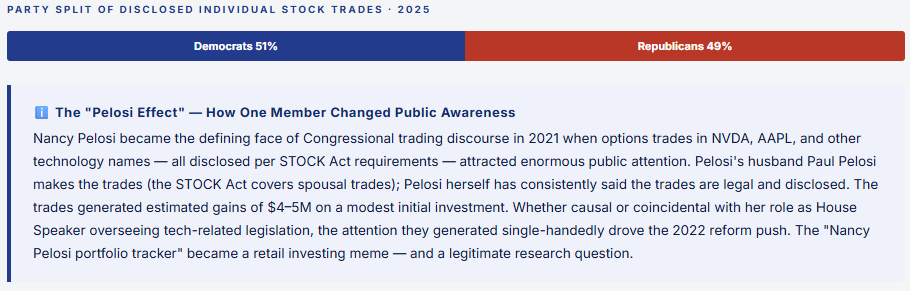
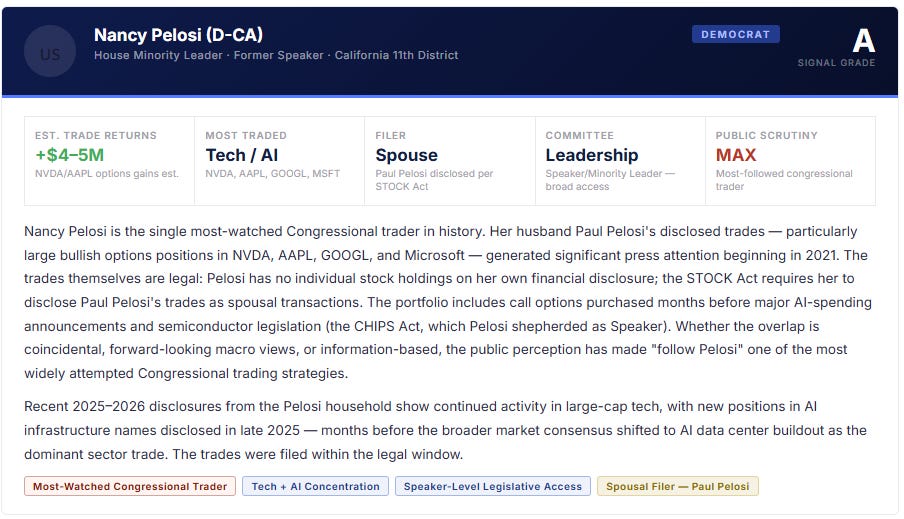
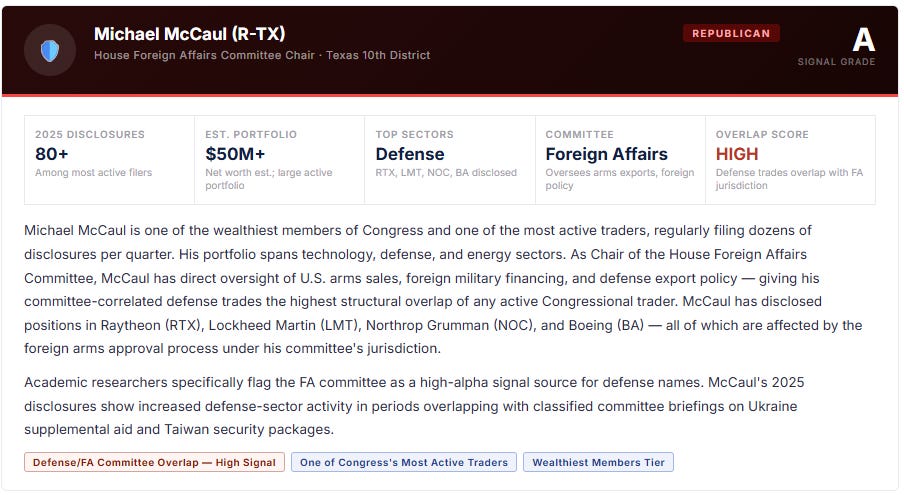
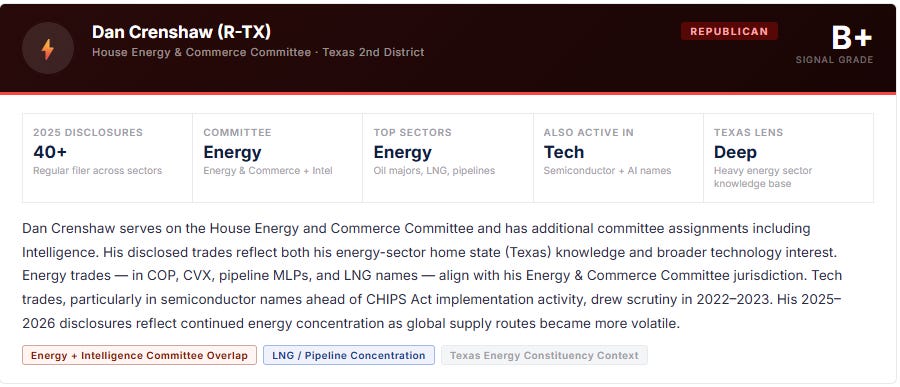
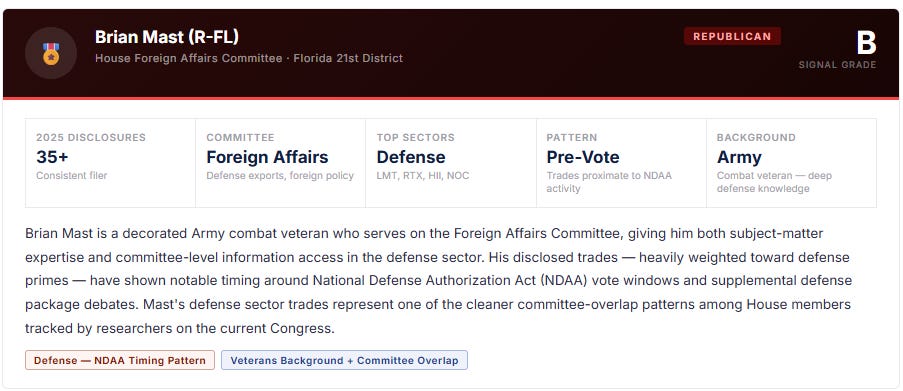
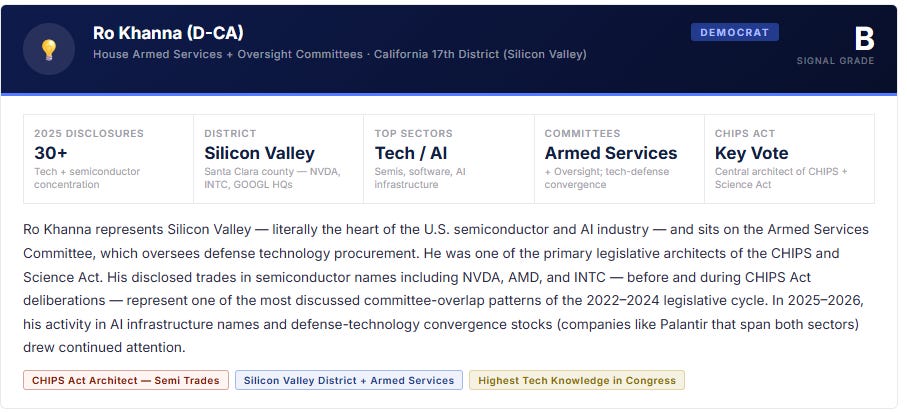
Contrary to popular perception, Congressional trading is bipartisan. Both Democrats and Republicans are active traders, and the most famous individual traders have come from both sides of the aisle — from Nancy Pelosi (D) to Tommy Tuberville (R) to Michael McCaul (R). The volume in any given year is dominated by about 10–15 members who file dozens or hundreds of disclosures, while the majority of the 535-member Congress files few or none.

Top Congressional Traders — Profiles
The Most Active and Most Profitable Disclosed Traders in Congress
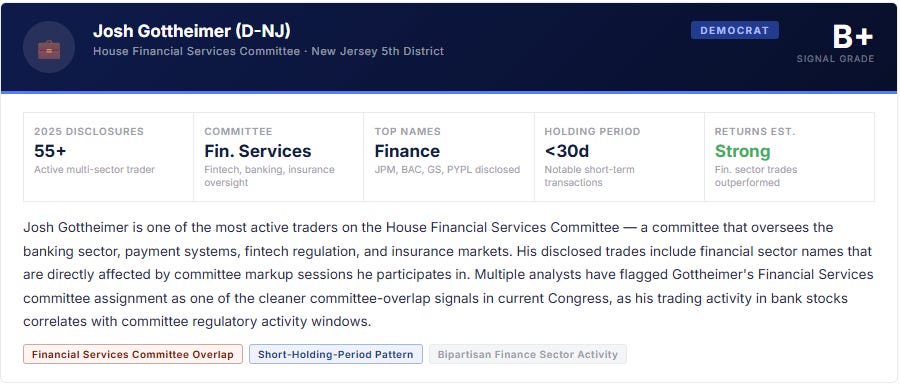
The profiles below represent the members with the most significant disclosed trading activity, highest estimated returns on their disclosed positions, or most notable committee-trade overlap. All information is drawn from mandatory STOCK Act filings.
Where Congress Is Concentrated
Sector Breakdown: Where Congressional Money Flows — and Why
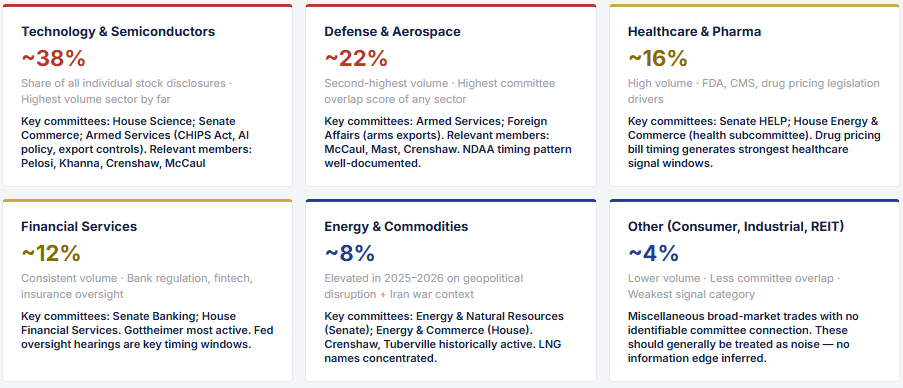
The sectors with the highest Congressional trading volume are not random. They map almost perfectly to the sectors with the most active legislative oversight — where committee information has the most advance signaling value. Technology and defense lead by volume; healthcare and financials follow. The committee-sector overlap data below is the most actionable part of any Congressional trading analysis.
🔍 The Committee Timing Window: When the Signal Is Strongest
Research consistently finds that Congressional trading returns are highest in the 30-60 day window before a significant committee markup, vote, or public hearing in the member’s assigned sector. The strongest signals are: (1) purchases in defense names by Armed Services members 30–45 days before NDAA conference report; (2) tech sector purchases by Commerce/Science committee members 30–60 days before semiconductor or export control legislation moves; (3) healthcare purchases by HELP/E&C members before CMS reimbursement announcements. The signal degrades significantly outside these windows — trades far from legislative events look like ordinary portfolio management.
