

The two-year-old AI cloud doubled revenue again, drew what looks like its first positive earnings reaction, and raised its buildout budget to nearly $40 billion. The whole trade now rests on one heavily leveraged balance sheet, and a $640 million quarterly interest bill that is, almost to the dollar, the entire net loss.
Section 1 · The Print
A beat, a first, and a bill that equals the loss
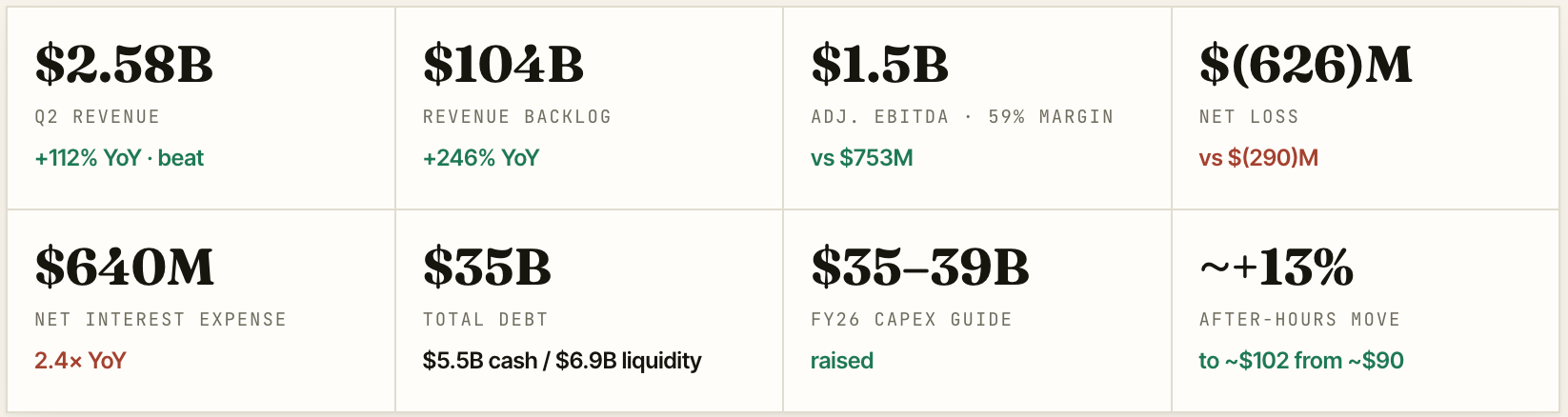
CoreWeave’s prior public-market prints were poorly received (Q1 2026 fell about 10% even on a beat). On the evening of August 11, 2026, that pattern appears to have broken: shares jumped roughly 13% in extended trading (to about $102 from a prior close near $90) after the company beat on both the top and bottom lines and raised full-year guidance. Reported For a name that had become shorthand for “priced for perfection,” what looks like its first clearly positive reaction is itself the story. Characterization
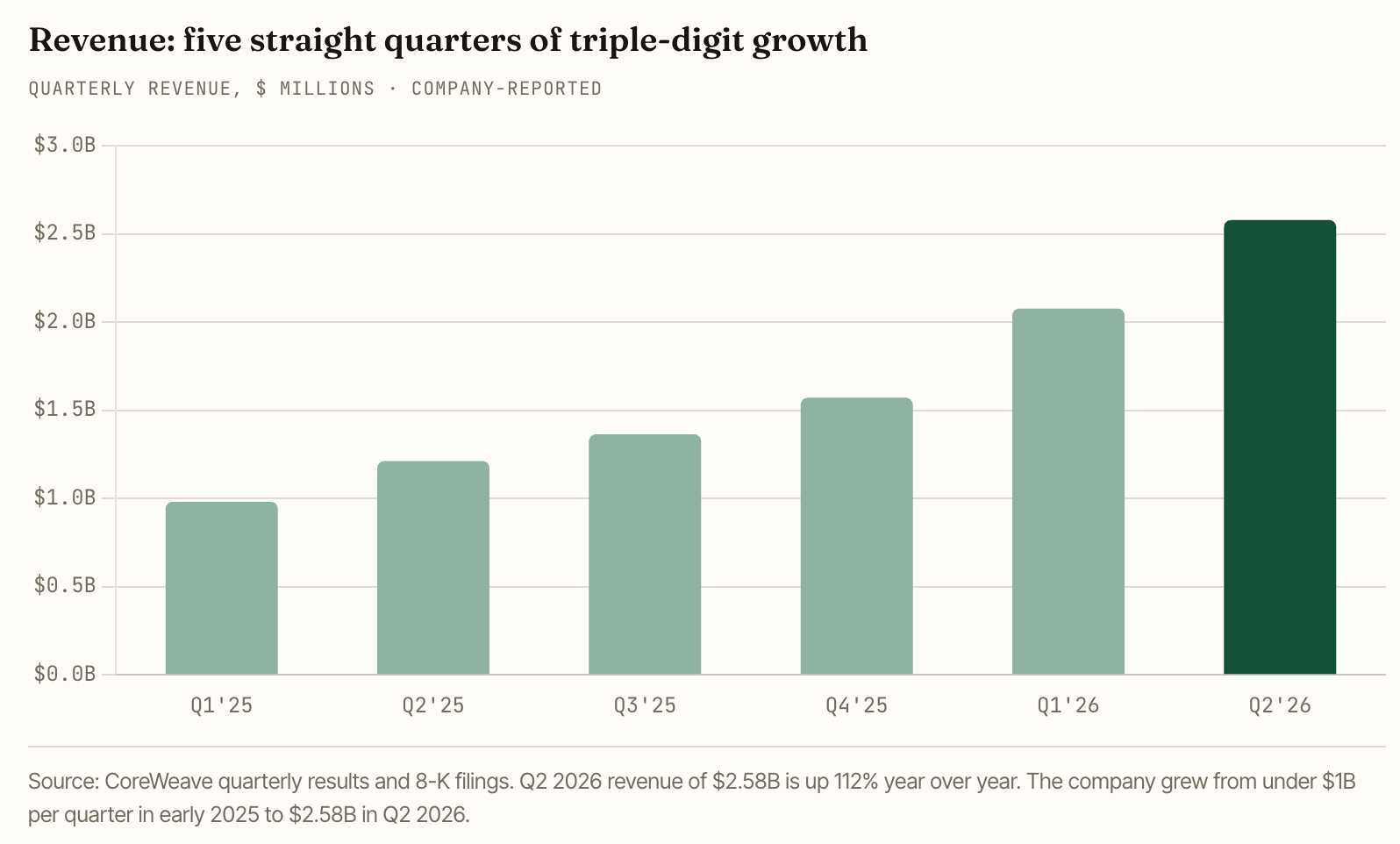
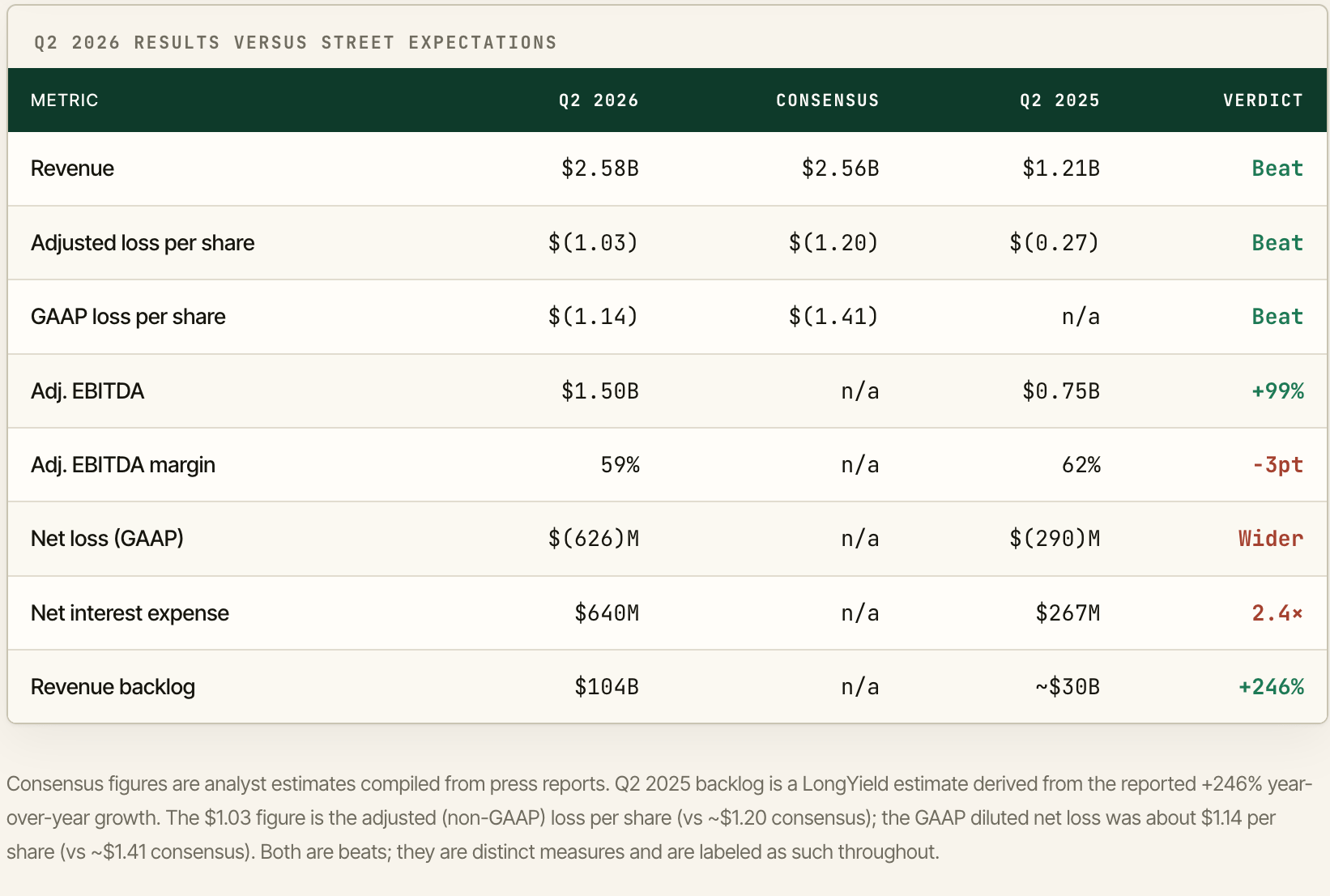
The quarter was, on its face, a blowout. Revenue landed at $2.58 billion, up 112% year over year and ahead of the roughly $2.56 billion analysts expected. Reported The adjusted loss came in at $1.03 per share against an adjusted consensus loss near $1.20, a smaller loss than feared. Reported On a GAAP basis the loss was wider, about $1.14 per share versus roughly $1.41 expected, so the two measures should not be conflated. Reported Adjusted EBITDA reached $1.5 billion, a 59% margin, roughly double the $753 million of a year earlier, though the margin itself slipped from about 62% a year ago to 59% as the fleet and its costs scaled. Reported
Then there is the number that frames everything else. Net loss widened to $626 million, from $290 million a year ago. The cause was not the operating business, which ran close to breakeven at the GAAP operating line. Derived The cause was the cost of the money. Net interest expense hit $640 million in the quarter, up from $267 million a year earlier, a 2.4-times jump. Reported Put plainly: the entire net loss for the quarter is, within a rounding error, the interest bill on the debt that built the data centers.
The operating business roughly broke even. The $626 million loss is essentially what CoreWeave paid its lenders.LongYield analysis of Q2 2026 results
That single fact captures the CoreWeave debate better than any valuation multiple. This is a business compounding revenue at triple-digit rates with genuine, contracted, blue-chip demand behind it, financed by one of the most aggressive debt-funded capital programs in the public markets. The bull sees operating leverage finally arriving. The bear sees a leveraged bet on the AI capital cycle where the interest clock never stops.
Section 2 · The Backlog
$104 billion of contracts, and who signed them
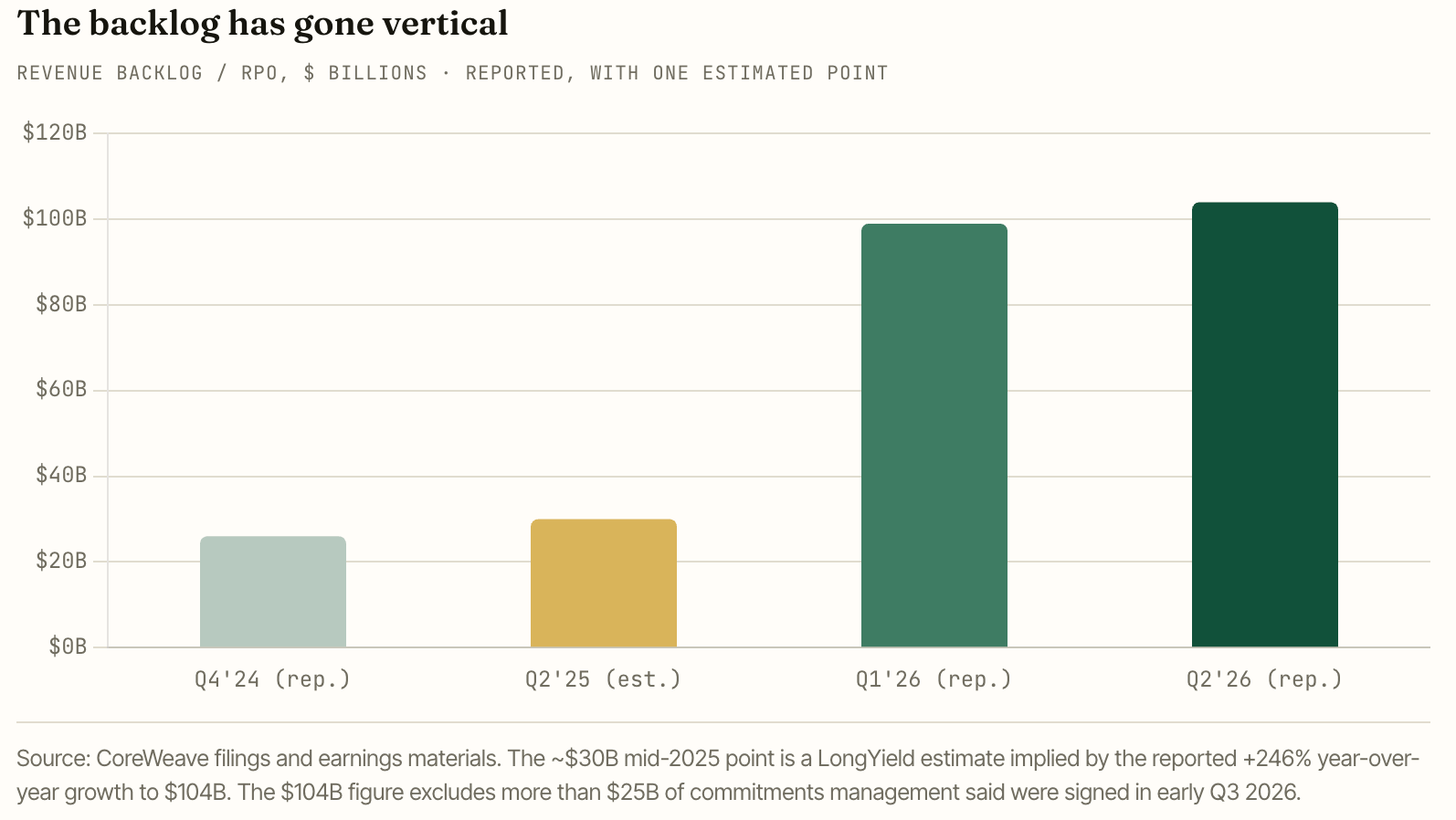
The most arresting number CoreWeave disclosed was not on the income statement. It was the revenue backlog of roughly $104 billion as of June 30, up 246% year over year, and, per management, that figure excludes more than $25 billion of net new customer commitments signed in the first weeks of the third quarter alone. Reported Against a company doing about $2.6 billion of quarterly revenue, a $104 billion backlog is roughly ten years of current run-rate demand already under contract.
Backlog here means remaining performance obligations plus additional amounts management estimates will be recognized under committed customer contracts. It is a real, contracted pipeline, but it is a forward promise, not cash in the bank, and a portion of it rests on the health of a small number of very large counterparties.
The concentration nobody can un-see
For all the diversification the backlog implies, near-term revenue remains startlingly concentrated. Microsoft accounted for roughly 67% of CoreWeave’s 2025 revenue. Reported A single hyperscaler, itself building its own AI data centers, is both CoreWeave’s largest customer and one of its most credible future competitors. If Microsoft’s own capacity catches up to its needs, the most important line in CoreWeave’s revenue base is also the one most exposed to insourcing.
The second pillar is OpenAI. Across a series of multi-year agreements, OpenAI has contracted up to roughly $22.4 billion of total commitments with CoreWeave. Reported During and around the quarter, CoreWeave also disclosed new business with Anthropic and Meta, extending the roster of frontier labs and hyperscalers renting its capacity. Reported The strategic read is that CoreWeave is becoming default overflow capacity for the entire frontier-model industry. The risk read is that this is a customer list of four or five names, several of which are also building the very infrastructure they are renting.
The concentration math
One customer (Microsoft) was about two-thirds of 2025 revenue. One more (OpenAI) carries up to ~$22.4B of contracted commitments. The backlog is enormous, but its quality is only as good as a handful of counterparties, most of whom have the balance sheets to build in-house.
CoreWeave is becoming the frontier labs’ overflow capacity. It is also renting to companies that can afford to become its competitors.LongYield Research Desk
Section 3 · The Machine and the Money
Nearly $40 billion of capex, and the debt that pays for it
To serve that backlog, CoreWeave is spending at a pace with few precedents. Capital expenditure was $6.4 billion in the quarter and $16.1 billion in the first half of 2026, against $4.8 billion in the first half of 2025. Reported Management raised full-year 2026 capex guidance to $35 billion to $39 billion and set a year-end target of more than 1.85 gigawatts of active power, up from roughly 1.5 gigawatts of active power exiting Q2 against about 3.7 gigawatts already contracted, as it deploys Nvidia’s Blackwell generation (GB200 and GB300 class systems) at scale.
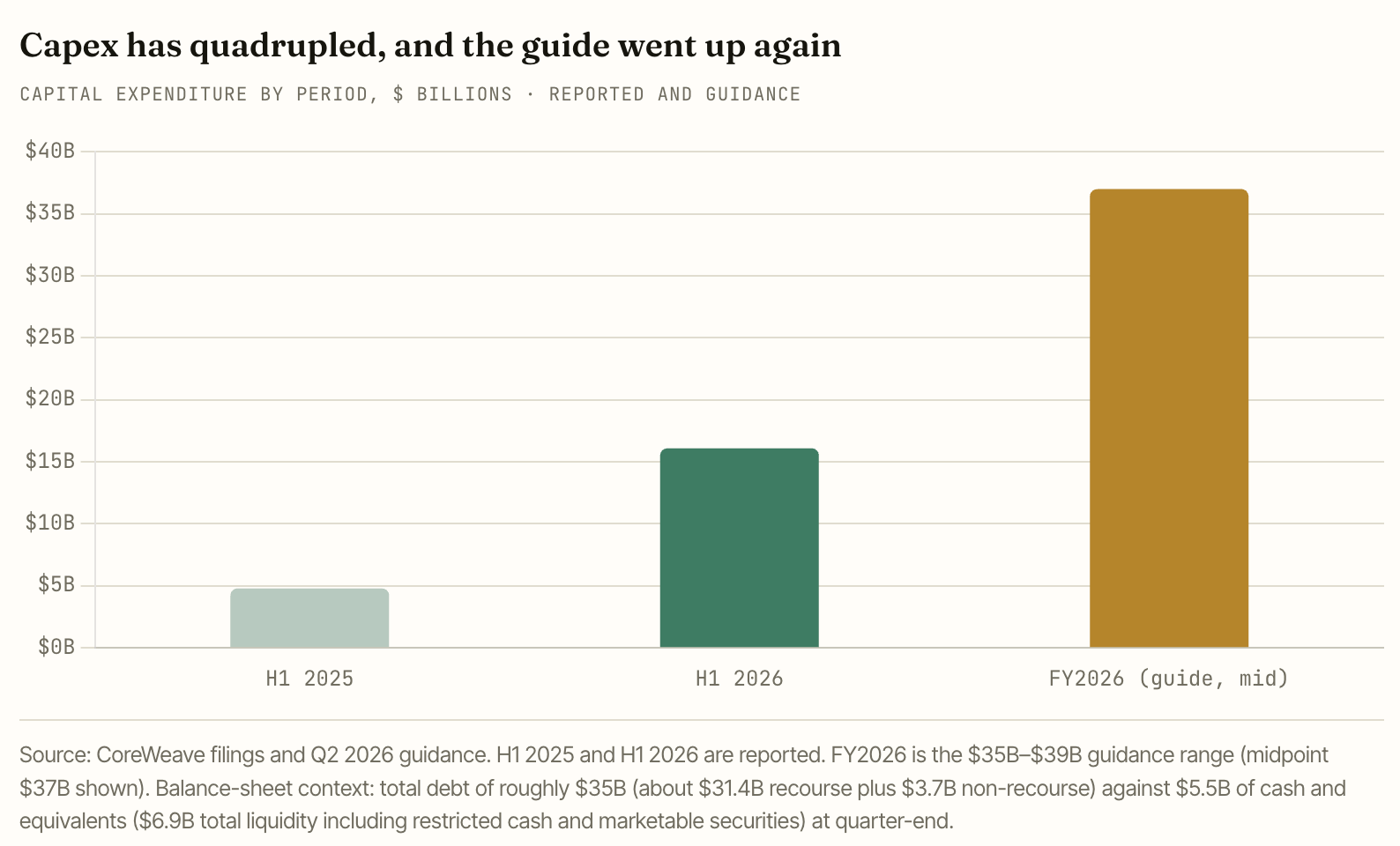
That spending is financed overwhelmingly with debt. CoreWeave ended the quarter with roughly $35 billion of total debt (about $31.4 billion recourse and $3.7 billion non-recourse) against $5.5 billion of cash and equivalents, or about $6.9 billion of total liquidity once restricted cash and marketable securities are included. Reported In and around the quarter the company layered on more: a $3.1 billion term loan it described as the first publicly syndicated facility of its kind, a $1 billion strategic investment from Jane Street, and roughly $10 billion of unsecured debt and convertible bonds. Reported The buildout is, structurally, a chain of GPU-collateralized borrowings sized against contracted revenue.
