
D-Wave's Quantum Leap: $33M Bookings, $2.9M Revenue, and the Hardest Question in Tech
The only company selling real quantum computers to real customers just booked nearly a year's worth of deals in a single quarter — and then pivoted to a completely different technology

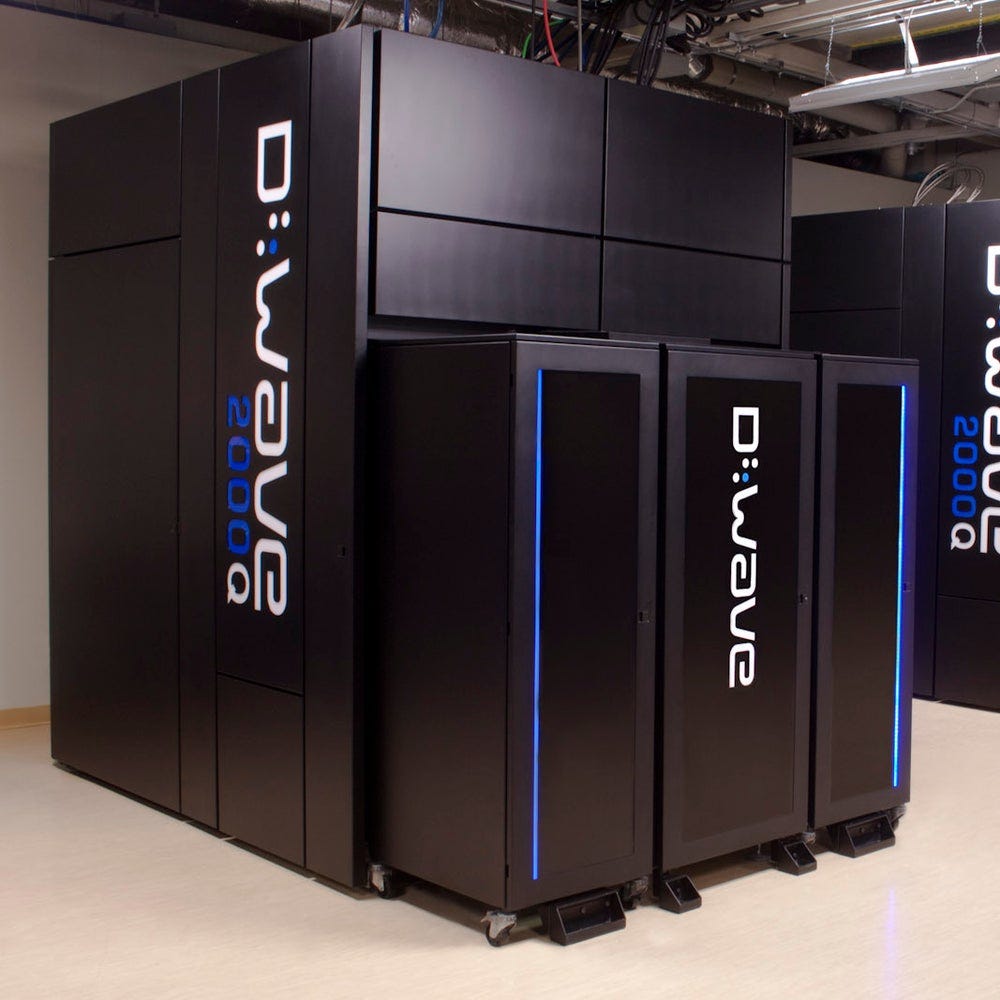
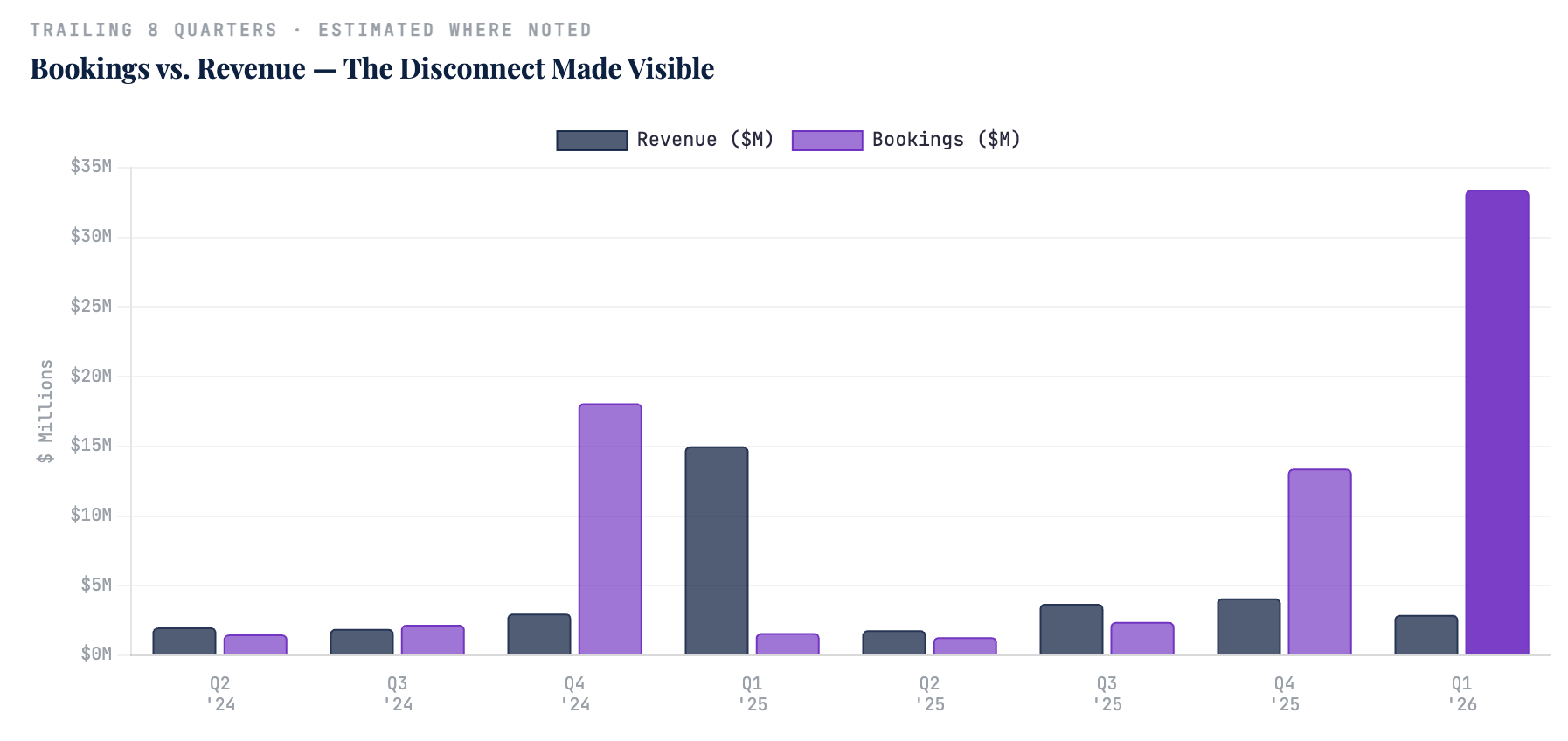
D-Wave Quantum reported Q1 2026 earnings today and the numbers are a study in contradictions that go to the heart of the most contested question in technology investing: when does quantum computing cross from science project to commercial reality? Revenue fell to $2.9 million — down 81% from a year ago and below Wall Street's $4.22 million estimate. But bookings surged to $33.4 million, a 1,994% increase year-over-year, anchored by a $20 million system sale to Florida Atlantic University and a $10 million two-year QCaaS contract with an unnamed Fortune 100 company. Meanwhile, D-Wave completed its $550 million acquisition of Quantum Circuits Inc. — a gate-model quantum startup — marking the most significant strategic pivot in the company's 24-year history. With $588.4 million in cash and a record backlog, D-Wave is either proof that quantum annealing has crossed into commercial reality, or a company papering over a broken revenue model with headline-grabbing deals. The answer to that question is the entire investment thesis.

Deep Dive Contents
The Full Structural Analysis
This is not a quarterly earnings recap. It is a full examination of D-Wave’s technology, business model, competitive position, financial trajectory, and the strategic logic — or lack thereof — of its pivot from pure-play quantum annealing into gate-model computing. The goal is to understand what D-Wave actually is before deciding whether its $8 billion market cap is a bargain or a trap.
Section 01 · The Numbers
A Tale of Two Metrics: When Bookings and Revenue Tell Opposite Stories
The first instinct when reading D-Wave’s Q1 2026 numbers is to decide which number to believe. Revenue of $2.9 million makes the company look like a tiny curiosity in a sector dominated by IBM’s billion-dollar R&D budgets and Google’s trillion-dollar balance sheet. Bookings of $33.4 million make it look like the only quantum company actually closing commercial deals at scale. Both numbers are real. The tension between them is the entire story.
Start with the revenue miss. Wall Street expected $4.22 million — a figure that would have represented roughly a 50% sequential increase from Q4 2025. D-Wave delivered $2.9 million instead. The primary driver of the miss is the structure of D-Wave’s revenue model: system sales, which run to tens of millions of dollars, are recognized over time rather than upfront as hardware and implementation milestones are reached, while QCaaS contracts generate subscription-style revenue that builds slowly quarter by quarter. The company had a monster Q1 2025 — $15 million in revenue — because it was recognizing a large system booking from late 2024. The year-over-year comparison of –81% is brutal as a result, but it is largely a timing artifact rather than a business deterioration signal.
Then there are the bookings. A $33.4 million bookings quarter — 1,994% above the year-ago period’s $1.6 million — is exceptional in absolute terms and even more striking when viewed against D-Wave’s historical trajectory. The company posted a full fiscal year 2024 of just $23.9 million in bookings. It just beat that in a single quarter. The primary driver was the $20 million Advantage2 system sale to Florida Atlantic University, with the $10 million Fortune 100 QCaaS deal as the secondary anchor. The remaining balance comes from a collection of smaller commercial engagements. Remaining Performance Obligations (RPO) hit a record $42.4 million — contracted future revenue not yet recognized — giving meaningful visibility into the coming 12-18 months.
CEO Alan Baratz framed the quarter characteristically: “D-Wave’s first quarter performance highlights what sets this company apart: strong execution, expanding commercial adoption, and differentiated technology leadership across both annealing and gate-model quantum computing.” On 2026 system sales pipeline, Baratz stated he has “a very high degree of confidence that we’ll see 2 or 3 sales this year and… a very high degree of confidence that we will actually deliver 2 of them.” On quarterly cadence, guidance was directional: Q2 is “likely to be up modestly from Q1, with a substantial portion of the year’s revenue recognized in the second half.”
⚠ The Bookings-to-Revenue Gap — What If Deals Don’t Convert?
D-Wave’s bookings-to-revenue conversion is lumpy by design: the $20M FAU system deal won’t be fully recognized until after hardware delivery (expected before year-end 2026) and installation milestones. The $10M Fortune 100 deal converts over two years — roughly $5M per year. A delay in hardware delivery, a technical setback with the Advantage2 production unit, or a customer renegotiation could push recognized revenue further right. The $42.4M RPO is a contractual promise, not a check. Q1’s revenue miss — despite the blockbuster bookings — is itself a reminder that bookings and revenue are not interchangeable in this business model, and that investors relying on bookings as a proxy for the business are reading only half the financial picture.
Full Financial Scorecard — Q1 2026
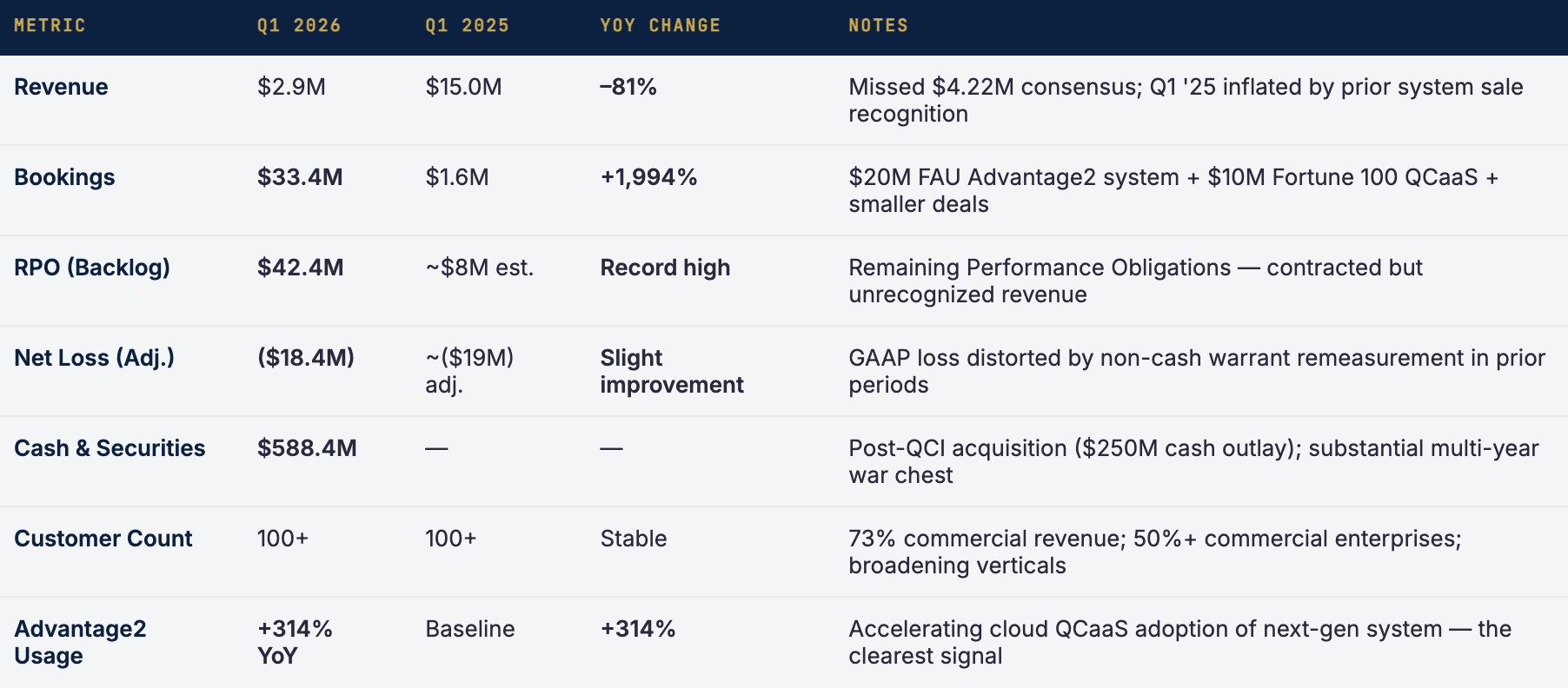
The 314% year-over-year growth in Advantage2 usage deserves more attention than it typically receives. It means existing customers who previously accessed D-Wave’s older Advantage system are migrating to the newer, more capable hardware — and doing more work on it. This is not speculative demand from first-time experimenters. These are organizations that have already committed budget to quantum computing, evaluated the technology, integrated it into workflows, and are now running more workloads on better hardware. Usage growth in a computing-as-a-service business is the cleanest leading indicator of future subscription revenue.
Section 02 · The Big Deals
Who Is Actually Buying Quantum Computers — And What It Signals About the Market
The identity of D-Wave’s two anchor Q1 deals tells a specific and underappreciated story about where quantum computing is gaining commercial traction. One is an academic institution making a landmark infrastructure investment. The other is a major corporation embedding quantum optimization into an operational workflow. Together, they represent the two most plausible entry points for quantum annealing revenue at scale.
Deal One — Florida Atlantic University: $20 Million
Florida Atlantic University’s $20 million commitment to purchase a D-Wave Advantage2 system is the largest academic quantum computer sale in history. The 4,400+ qubit annealing system will be installed at FAU’s Boca Raton campus before the end of 2026, establishing FAU as a major quantum computing research hub. A separate Memorandum of Understanding covers the potential creation of a D-Wave Quantum Applications Academy, research partnerships, graduate training, and workforce development initiatives.
The strategic symmetry is deliberate and notable: D-Wave simultaneously announced it is relocating its corporate headquarters to the Boca Raton Innovation Center, the same facility housing FAU’s tech programs. The university gets the machine and becomes a research hub. D-Wave gets an anchor customer, a talent pipeline, and a Florida headquarters. Both parties benefit from proximity to Miami’s emerging tech corridor and the state’s active quantum computing policy agenda. This is a thoughtfully constructed ecosystem play, not just a hardware sale.
What will FAU actually do with the Advantage2? The system is purpose-built for combinatorial optimization: finding the best configuration among exponentially large solution spaces. Academic applications include materials science simulations (three-dimensional lattice problems, where D-Wave has demonstrated 25,000x speedups over prior hardware), drug discovery and protein configuration, machine learning optimization, logistics research, and scheduling problems with industrial partners. The Advantage2 will attract federal grants, corporate research contracts, and graduate students — generating a secondary commercial ecosystem around the hardware purchase itself.
Why Universities Buy Quantum Computers — And Why It Matters Commercially
The FAU purchase continues a pattern that dates to D-Wave’s earliest days: academic institutions serving as first-mover anchor customers. NASA, Google, and Lockheed Martin all purchased D-Wave systems through the Universities Space Research Association (USRA). Universities and national labs (Los Alamos, Oak Ridge) built the use-case library and trained the workforce. The FAU deal is larger and more commercially structured than those early academic deployments, but the dynamic is familiar: university deployments validate technology, generate published research that demonstrates applications, and train the engineers who eventually bring quantum tools into enterprise and defense settings. FAU’s Advantage2 could catalyze the same commercial ecosystem in Florida’s emerging quantum corridor that early academic deployments built in California and New Mexico.
Deal Two — Fortune 100 QCaaS Agreement: $10 Million Over Two Years
The $10 million, two-year Quantum Computing as a Service agreement with an unnamed Fortune 100 company is arguably the more commercially meaningful deal of the two — and the more mysterious. D-Wave has not disclosed the customer’s identity. Baratz described it as a “record-setting” QCaaS agreement and characterized it as validation of “growing demand for our annealing systems.” At $5 million per year for cloud-based quantum annealing access, this is a serious operational budget commitment, not a pilot program.
Fortune 100 companies do not sign multi-year, eight-figure technology contracts for proof-of-concept experimentation. This is an enterprise that has completed the evaluation phase, quantified the value of quantum annealing for a specific workflow, and decided it is worth a sustained contractual commitment. The use case is almost certainly in the optimization domain — supply chain scheduling, financial portfolio optimization, logistics routing, energy grid optimization, or manufacturing planning. The two-year term signals confidence in value delivery. A one-year pilot becomes two years when results justify renewal; this customer apparently signed a two-year commitment from the outset.
The anonymity is standard practice for large enterprise tech contracts and tells us little. The $5M/year annual contract value is the data point that matters. For reference, most enterprise SaaS contracts in the $1-3M/year range are considered significant mid-market deals. A $5M/year quantum computing contract from a company with $20B+ in revenue represents a meaningful budget allocation — the kind of commitment that gets a quantum team a seat at the strategic technology table.

D-Wave’s 100+ customer base spans industries that optimization problems touch universally. Known and reported past customers include Volkswagen (traffic flow routing, tested on 10,000 vehicles in Lisbon), NTT (network optimization), BBVA (financial portfolio risk), Los Alamos and Oak Ridge National Laboratories (defense and scientific computing), and Denso (automotive manufacturing scheduling). The breadth of verticals is itself evidence that the combinatorial optimization problems D-Wave attacks are genuinely pervasive across the global economy. Every major manufacturing company, logistics provider, financial institution, and energy utility has scheduling and resource allocation problems of the exact type that quantum annealing is engineered to address.
Section 03 · The Technology
Quantum Annealing: What D-Wave Actually Does, and Why the Qubit Count Comparison Misleads
The phrase “quantum computing” covers a heterogeneous set of technologies that are as different from each other as a specialized graphics processor is from a general-purpose CPU. IBM’s 156-qubit Heron system and D-Wave’s 4,400-qubit Advantage2 are both quantum computers in the same way that a Formula One car and a semi-truck are both vehicles: they share underlying physics and a general domain, but they are built for fundamentally different problems and cannot substitute for each other. Comparing them by qubit count is roughly as meaningful as comparing a race car and a truck by horsepower.
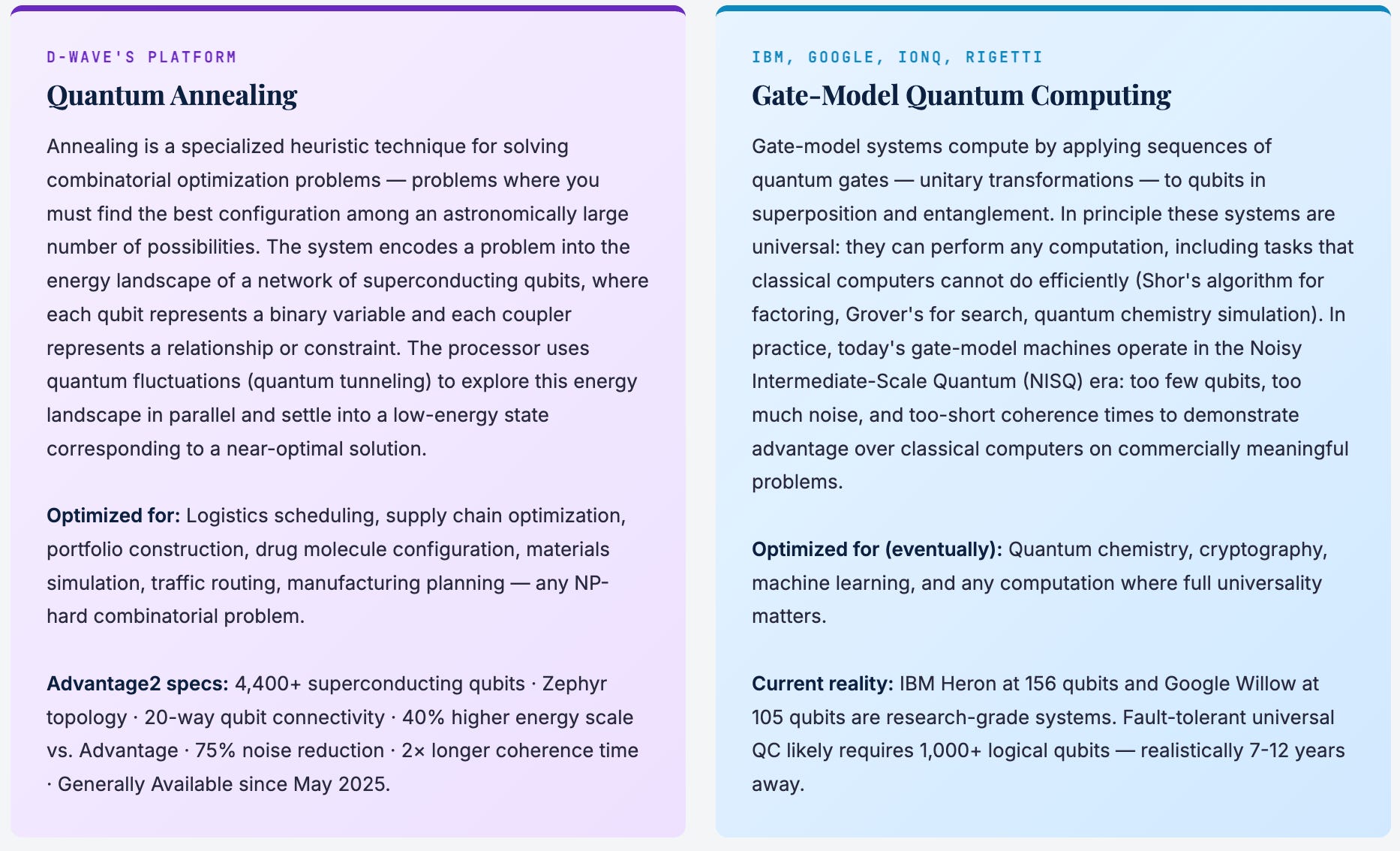
The key distinction for investors is this: annealing computers are not general-purpose, but they work today. Gate-model computers aim to be universal and transformative, but they are not yet powerful enough to solve problems that classical computers cannot handle. D-Wave’s Advantage2 has already demonstrated quantum advantage — measurable performance superiority over classical hardware — on specific optimization benchmarks. The 25,000x speedup over the previous Advantage system on three-dimensional lattice problems is not a theoretical projection; it is a measured result from a production system being used by paying customers right now.
This distinction matters enormously for the investment thesis. The “quantum computing isn’t real yet” narrative that pervades financial media is largely, and correctly, referring to universal gate-model systems. D-Wave’s annealing computers are real, deployed, and generating revenue. The debate is not about whether the technology works — it demonstrably does. The debate is about whether the optimization problems it solves are large and valuable enough in aggregate to justify D-Wave’s $8 billion valuation.
“Our record-setting $10 million quantum computing as a service agreement with a Fortune 100 company reinforced growing demand for our annealing systems. D-Wave’s first quarter performance highlights what sets this company apart: strong execution, expanding commercial adoption, and differentiated technology leadership across both annealing and gate-model quantum computing.”
— Alan Baratz, CEO, D-Wave Quantum · Q1 2026 Earnings Call, May 12, 2026
What Quantum Annealing Is Good At — Verified Commercial Use Cases
Logistics & Supply Chain: Vehicle routing problems (VRP) — finding optimal delivery routes for fleets — map naturally to QUBO (Quadratic Unconstrained Binary Optimization), the native format for annealing. Volkswagen tested quantum-aided traffic routing for 10,000 cars in Lisbon. NTT has used annealing for telecoms network optimization.
Financial Services: Portfolio optimization — constructing the maximum-return combination of assets for a given risk level — is a canonical QUBO problem. BBVA, banks, and hedge funds have tested D-Wave for risk modeling and asset allocation. The Fortune 100 QCaaS customer may well be in this vertical.
Drug Discovery & Materials: Finding the lowest-energy configuration of a molecule or material — critical for drug design and materials engineering — is an optimization problem. The Advantage2’s 25,000x speedup on 3D lattice problems directly enables faster molecular simulation. Multiple pharmaceutical companies are in D-Wave’s pipeline.
Manufacturing & Scheduling: Job-shop scheduling — assigning N jobs to M machines in optimal order — is NP-hard and maps well to annealing. Denso and other manufacturers have tested quantum-aided production planning. As Advantage2 scales, real-time factory scheduling becomes achievable.
Defense & National Security: Radar network optimization, asset allocation, mission planning, and intelligence analysis problems. Los Alamos National Laboratory and Oak Ridge National Laboratory are active D-Wave users; DoD applications represent a growing portion of the pipeline.
The Advantage2 is D-Wave’s sixth hardware generation, following a lineage from the 128-qubit D-Wave One in 2011 through the original Advantage (5,000+ qubits in 2020). Each generation has improved qubit count, connectivity, coherence, and noise characteristics. The Zephyr topology used in Advantage2 increases per-qubit connectivity from 15 neighbors in the older Pegasus topology to 20 — expanding the class of problems that can be encoded natively without the computational penalty of embedding transformations. That 40% increase in effective problem density means Advantage2 can tackle classes of industrial optimization problems that were previously too large or too densely connected for the hardware to represent faithfully.
Section 04 · The Strategic Pivot
The Quantum Circuits Acquisition: $550 Million to Become a Different Company
