

EQT and Range Resources both reported Q2 2026 after Tuesday's close. EQT smashed volume guidance, raised the full year by 90 Bcfe, and — the headline — signed a 10-year, PJM-linked gas supply deal for a 2-gigawatt power plant in West Virginia. Range beat earnings by a wide margin and nearly tripled its buyback. Here is the full scorecard against our seven-point watchlist.
Section 01
What Happened: Two Prints, Two Different Beats
The doubleheader delivered — just not where consensus was looking. EQT posted adjusted EPS of $0.39 against a ~$0.41–0.42 Street estimate, a modest miss driven entirely by the price line: realized pricing of $2.65/Mcfe came in below last year’s $2.81 as NYMEX averaged just $2.89 for the quarter. But everything EQT controls, it beat: sales volume of 634 Bcfe cleared the top of the 570–620 guidance range, capex of $666 million landed 9% below the low end, and per-unit operating costs of $1.03/Mcfe printed at the very bottom of guidance. Range, meanwhile, delivered the clean beat: adjusted net income of $186 million, or $0.79 per diluted share, against a ~$0.67 consensus — roughly 17% ahead — on GAAP revenues of $834 million and net income of $195 million ($0.83).
The pattern matters more than the numbers. EQT’s “miss” is a commodity-price artifact layered on top of operational outperformance so strong that management raised full-year production guidance by ~90 Bcfe (to 2,375–2,450 Bcfe) while cutting capex guidance by $25 million — the compression investments are shallowing decline curves across both existing and new wells. Range’s beat came from exactly the place our preview said it would: the liquids ballast. Pre-hedge NGL realizations of $29.10/bbl — a $3.49 premium over Mont Belvieu — plus a $0.64/Mcfe blended premium over NYMEX gas kept the cash machine running through a sub-$3 gas tape.
The One-Paragraph Verdict
The pair thesis survived contact with the results — and the torque leg got its catalyst. EQT converted the AI-power narrative into a signed contract: a 10-year definitive agreement with Competitive Power Ventures to supply 325,000 Dth/d to the 2-GW CPV Shay Energy Center in Doddridge County, WV — with pricing linked to PJM power prices, a substantial uplift over in-basin gas. That is the first at-scale proof that Appalachian producers can capture power-market economics, not just molecule economics. Range played its ballast role to perfection: earnings beat, differentials guidance improved across all three streams, and capital returns accelerated hard. One caution flag: EQT quietly added heavy 2027 hedge cover — the conviction trade got a seatbelt.
Section 02 · NYSE: EQT
EQT: A Price Miss Wrapped Around an Operational Beat
Put the two quarters side by side and the commodity whiplash is stark: Q1’s $5.08/Mcfe realization became Q2’s $2.65 — winter premium to shoulder-season glut in ninety days. Net income attributable to EQT fell to $211 million from $784 million a year ago (a figure inflated by a ~$720 million unrealized derivatives gain in that quarter — Q2 2025’s realized price was actually just $2.81). Adjusted EBITDA still rose year-over-year to $1.203 billion, and free cash flow attributable to EQT of $330 million beat last year’s $240 million — in a materially worse price environment. That is the integrated cost structure doing its job.
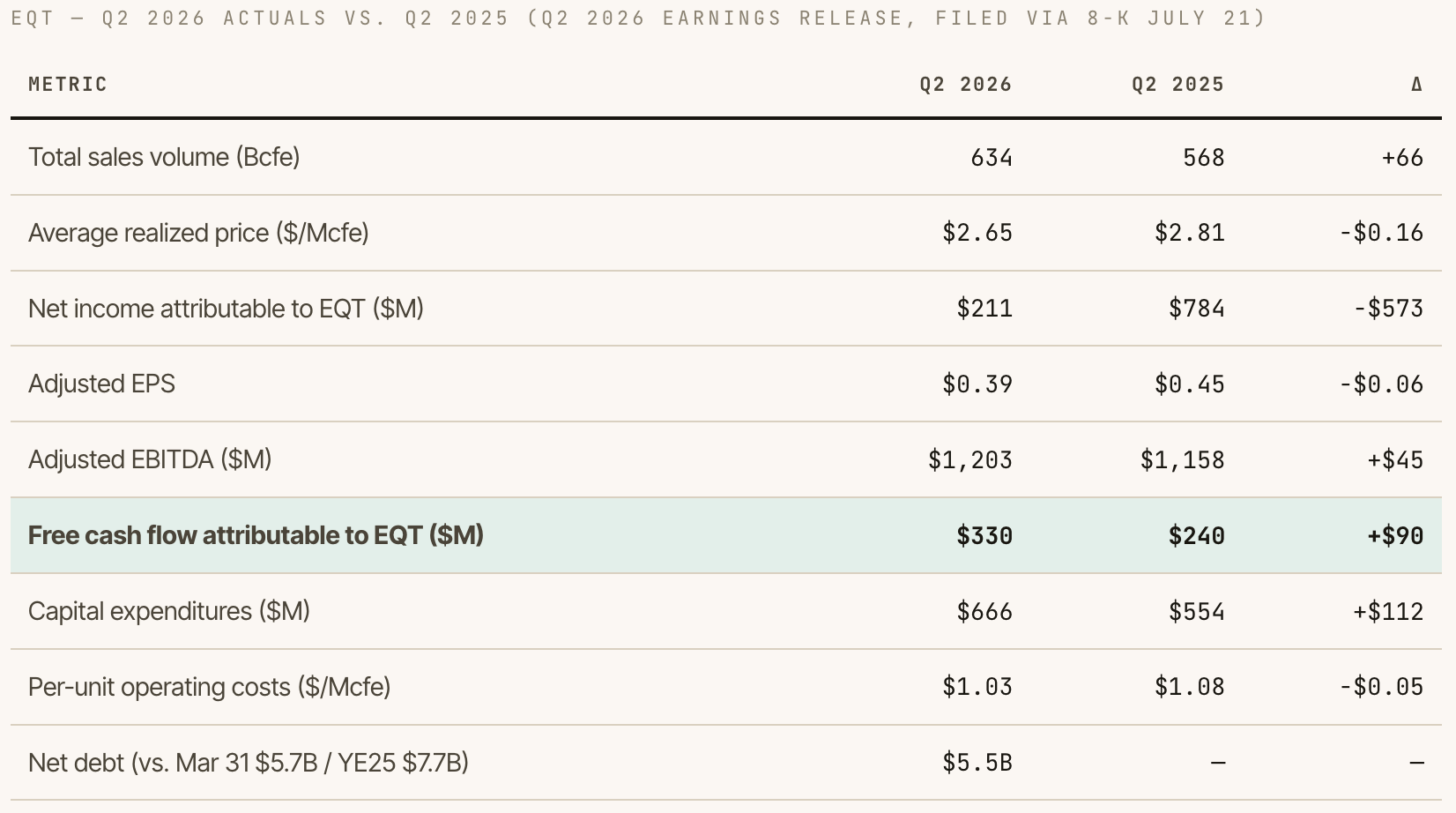
The balance sheet keeps melting toward target: net debt of $5.54 billion at June 30 (total debt $5.66B, only $52M drawn on EQT’s own revolver), with another $115 million of 2026 debentures repaid after quarter-end. The $5 billion long-term target is now one ordinary half-year of free cash flow away. Guidance for Q3 mirrors Q2’s setup — 570–620 Bcfe, maintenance capex stepping down to $510–580M — but the full-year raise is the tell: management now expects 2,375–2,450 Bcfe on less capital.
The CPV Shay Deal: The Backyard Bid Becomes a Contract
Our preview’s watchlist item #3 asked for “any concrete datacenter supply agreement” as the headline that transcends the quarter. EQT delivered something arguably better: a 10-year definitive agreement to supply 325,000 Dth/d to CPV’s Shay Energy Center — a new ~2-gigawatt gas-fired power plant in Doddridge County, West Virginia — with pricing linked to PJM power prices rather than local gas hubs. Toby Rice’s framing was explicit: the next wave of gas demand growth is emerging “in our backyard,” and EQT is positioning as “the partner of choice in Appalachia” for power generators and datacenter developers. The structural significance: this converts a slice of EQT’s production from Appalachian basis-taker to PJM power-price participant, a fundamentally better revenue quality. Alongside it, EQT signed a 5-year LNG offtake SPA (0.5 MTPA, starting 2028) with a large Asian integrated energy company worth ~$45 million of incremental 2028 FCF at strip, accelerated $85 million into MVP Southgate to complete it by year-end, and closed the $77 million Blackline Midstream propane-terminal acquisition at a ~20% projected FCF yield.
The Caution Flag: EQT Bought a Seatbelt for 2027
In April, EQT’s 2027 hedge book was nearly bare — 48 MMDth in Q1 2027, fading to 13 by Q4 — and our preview framed that openness as management’s clearest conviction signal on the AI-power demand curve. The new disclosure shows a different posture: Q2 2027 hedged volume is now 138 MMDth and Q3 2027 is 140 MMDth (~1.5 Bcf/d), built from swaps at $3.16/Dth plus $3.00/$4.51 collars. Per the framework we laid out before the print, adding cover was the caution signal. It doesn’t kill the bull case — the CPV deal and LNG SPAs are the structural upside now — but it does mean shareholders own less raw 2027 gas-price torque than they did three months ago, at swap levels that lock in a distinctly un-heroic $3.16.
Section 03 · NYSE: RRC
Range: The Ballast Beat, and the Buyback Woke Up
Range’s quarter reads like a proof-of-concept for the liquids thesis. Production averaged 2.30 Bcfe/d (~67% gas, ~33% liquids), up from 2.21 in Q1 and squarely on the ramp toward the new full-year guide of 2.35–2.40 Bcfe/d. The blended realized price of $3.53/Mcfe including hedges stood a full $0.64 above NYMEX gas — in a quarter when Range’s own gas differential was negative $(0.47)/Mcf. The entire premium came from the liquids stream: pre-hedge NGLs at $29.10/bbl (+$3.49 over Mont Belvieu) and condensate at $83.96/bbl. Cash unit costs actually fell 3% year-over-year to $1.92/Mcfe, helped by a 46% collapse in per-unit interest expense — the dividend of last quarter’s 8.25% notes redemption.
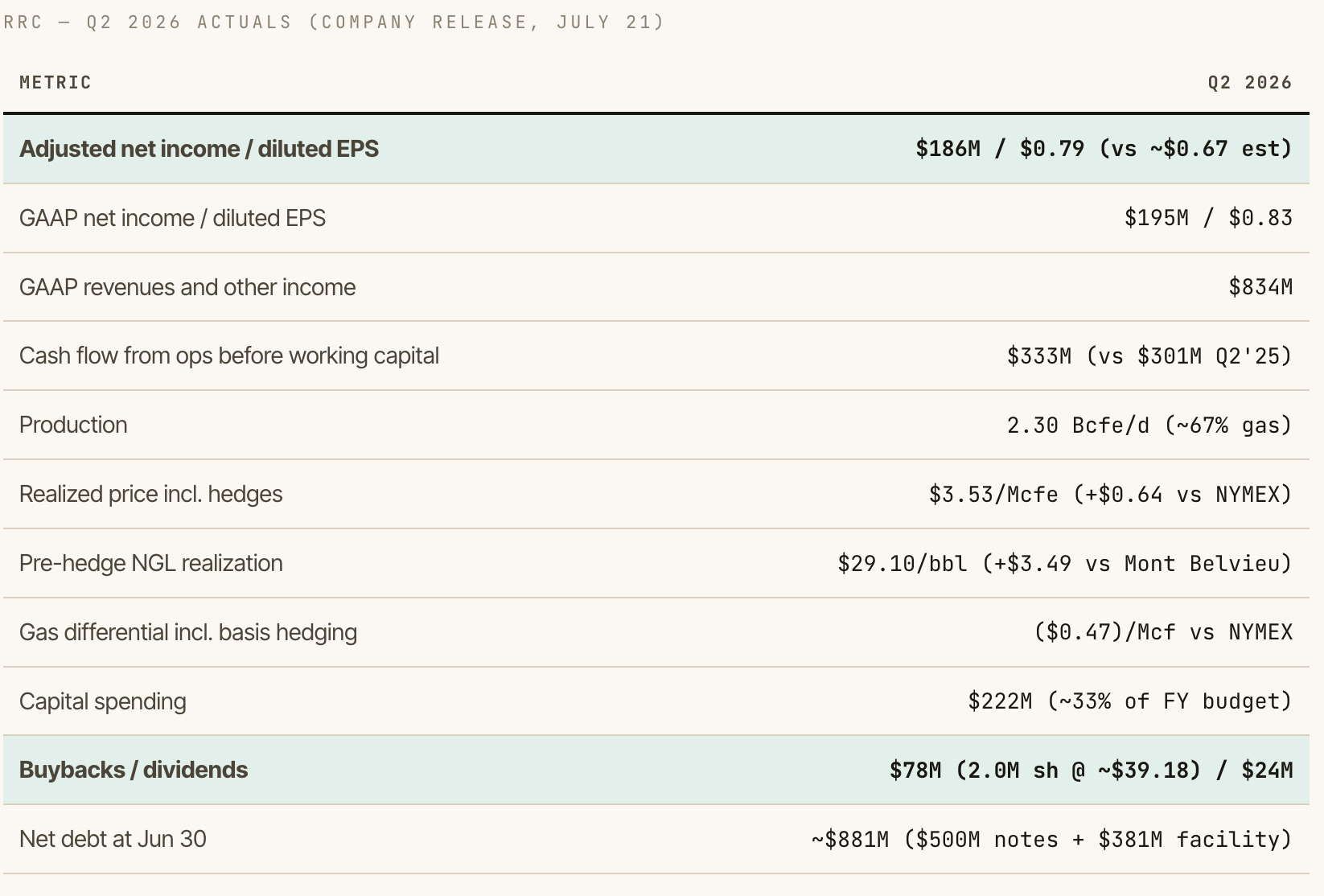
Watchlist item #7 asked whether “opportunistic” would turn into action. It did, emphatically: $78 million of repurchases versus $27 million in Q1 — 2 million shares at an average ~$39.18 — with $1.4 billion still available under the program. Net debt ticked up modestly to ~$881 million from $834 million, a deliberate trade: with leverage around half a turn, Range spent the quarter’s flexibility on share count rather than further deleveraging. Management also improved full-year differential guidance across all three streams — gas to NYMEX −$0.35/−$0.40 (from −$0.35/−$0.45), NGLs to Mont Belvieu +$2.00/+$2.50 (from +$1.25/+$2.50), condensate to WTI −$10/−$12 (from −$10/−$14). The operational records kept coming too: 1,900 frac stages completed by two crews, a 22-hour single-day pumping record, and nearly two miles drilled in a single day.
The soft spots are real but small: direct opex per Mcfe rose 18% to $0.13, G&A rose 13% to $0.18, and the quarter’s gas basis flipped from Q1’s +$0.18 premium to −$0.47 as regional differentials widened — a reminder that even Range’s transport book can’t fully escape a saturated in-basin market. The pre-announced derivatives figure landed exactly as filed: a $74 million mark-to-market gain with $35 million of net cash settlements.
Section 04
