

Iridium's latest results reveal a slow-growing cash machine, a collection of strategically scarce assets, and a merger spread that now matters more than the quarter.
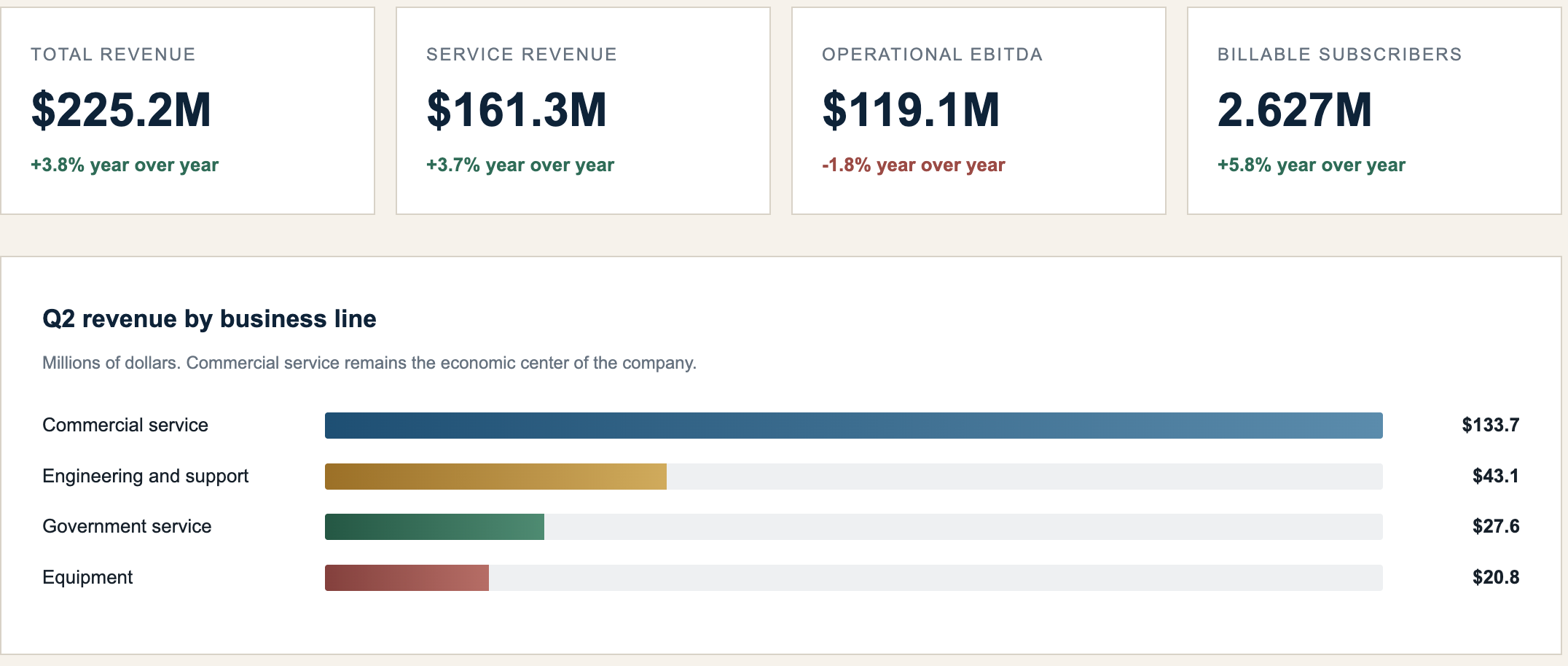
t first glance, Iridium’s second quarter was almost uneventful. Revenue increased 4%, recurring service revenue increased 4%, subscribers rose 6%, and Operational EBITDA declined 2%. Those numbers do not normally justify an $8 billion enterprise value. They do, however, explain why Rocket Lab decided that buying Iridium was faster, safer, and potentially cheaper than trying to recreate it.
The core thesis
Rocket Lab is not paying a premium for Iridium’s current growth rate. It is paying for time, globally coordinated spectrum, a functioning pole-to-pole network, millions of connected devices, government trust, recurring cash flow, and a shortcut into space-based applications.
Q2 2026 at a glance
The quarter showed a stable operating franchise, but not a growth acceleration. The earnings release also contained less narrative detail than usual because Iridium will not hold quarterly calls or update guidance while the Rocket Lab transaction is pending.
The quarter was stronger than the headline earnings decline
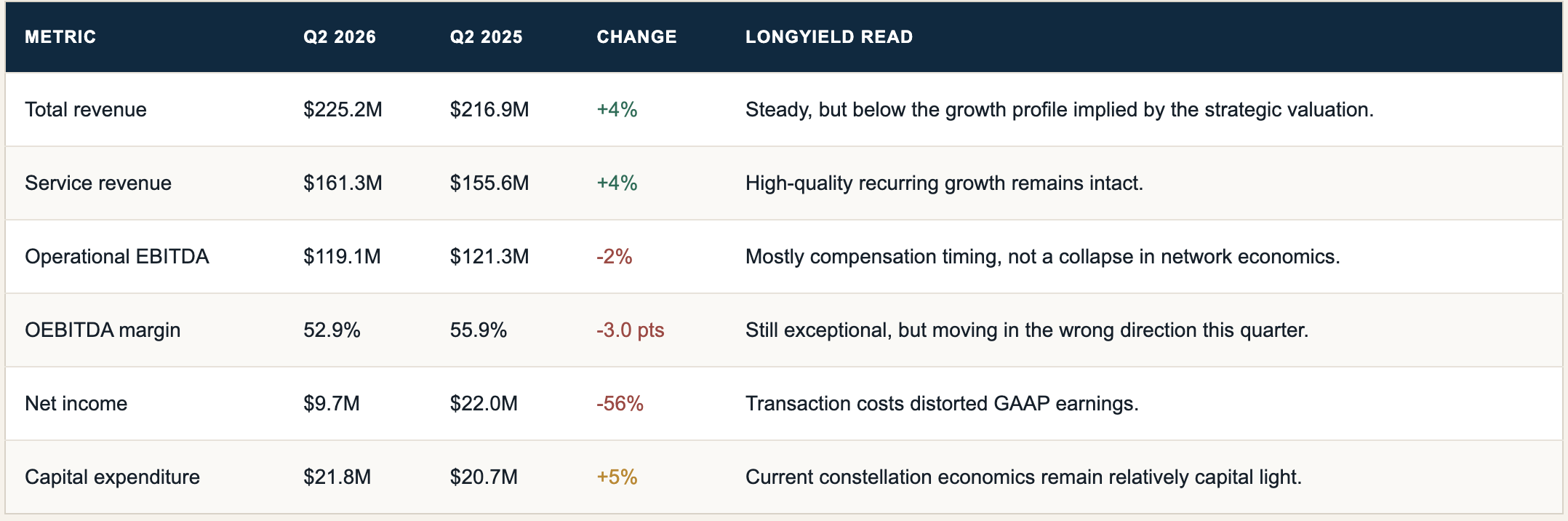
Net income fell from $22.0 million to $9.7 million, and operating income fell from $50.3 million to $34.0 million. That looks alarming until the expense bridge is examined. Selling, general, and administrative expense increased to $67.0 million from $44.6 million, while Iridium recorded $14.3 million of transaction-related expenses tied to strategic deals. The company also accrued an additional $3.9 million because annual incentive compensation is now being paid entirely in cash rather than through a mix of cash and equity.1
Operational EBITDA strips out the transaction charges and share-based compensation. Even on that adjusted basis, EBITDA declined 2%, so the quarter was not perfect. Still, the decline was small relative to the drop in GAAP income. The underlying service franchise remained profitable, recurring, and highly cash generative.
For the first six months of 2026, operating cash flow was $185.8 million and capital expenditure was $51.8 million. A simple operating cash flow less capital expenditure calculation produces roughly $134.0 million of free cash flow, compared with $145.4 million a year earlier. That is an 8% decline, but it also demonstrates why Iridium is unusual within the public space sector: it already produces meaningful cash rather than merely projecting it.2
Iridium is one of the rare space companies where the strategic story is supported by an existing cash flow engine.
The IoT engine is working, but the economics are changing
Commercial IoT revenue increased 5% to $47.1 million, while IoT subscribers increased 9% to 2.091 million. Iridium added 72,000 net commercial IoT subscribers during the quarter, almost double the 39,000 added in the comparable period last year. This was the clearest operating bright spot.
The catch is that IoT average revenue per unit declined 2% to $7.64 per month. Subscriber growth is outpacing revenue growth, which means the incremental device mix is moving toward lower-revenue applications. This is not necessarily bad. A low-power tracker, maritime sensor, emergency communicator, or industrial monitoring device may generate limited monthly revenue but require very little incremental network cost. At sufficient scale, low ARPU can still produce attractive contribution margins.
The real question is whether Iridium can expand the device universe fast enough to offset the lower revenue per connection. Two products matter here.
The Iridium 9604
The new Iridium 9604 module combines Short Burst Data satellite connectivity, LTE-M cellular connectivity, and GNSS positioning in one compact platform. Iridium says the design can reduce board space by 60% or more and lower integration complexity for device makers. Commercial availability began in June.3
This is more important than it sounds. Satellite IoT adoption is often constrained less by demand than by hardware cost, power consumption, antenna design, and engineering complexity. A tri-mode module allows an asset to use cheaper terrestrial connectivity when available and switch to satellite only when necessary. That can turn satellite from a primary network into an insurance layer, which substantially expands the addressable market.
Iridium NTN Direct
Iridium plans to introduce its standards-based NB-IoT non-terrestrial network service later in 2026. Live over-the-air demonstrations are underway with mobile network operators, semiconductor companies, and existing partners. The product is designed for messaging, low-cost IoT, and selected direct-to-device use cases.4
Investors should be precise about what this is and what it is not. Iridium NTN Direct is not initially a full mobile broadband substitute. It is a narrowband, standards-based service optimized for reach, reliability, power efficiency, and small data payloads. Starlink and AST SpaceMobile are pursuing higher-bandwidth direct-to-cell architectures. Iridium is targeting a different part of the market, where battery life, global coverage, and dependable small-message delivery matter more than streaming speed.
The IoT paradox
Lower ARPU looks like a weakness when viewed per subscriber. It can become a strength if lower device cost and standardized connectivity expand Iridium from millions of specialized terminals into tens of millions of embedded endpoints.
