
Roblox’s Algorithm Broke the Quarter. The Bigger Bet Is Still Intact.

Revenue rose 36%, but bookings slowed to 8% and the next quarter could decline sharply. Roblox is deliberately trading near-term monetization for safety, retention, and AI. Investors now have to decide whether this is temporary self-disruption or the start of structural weakness.

Roblox did not report a normal earnings miss. It reported the financial cost of changing what the platform rewards, who can communicate, how users prove their age, and where the company intends to spend the next generation of computing capacity.
The market responded as if the growth story had broken. Roblox shares fell roughly 27% on July 31, closing near $35.60 and erasing billions of dollars in market value. That reaction was understandable. The company guided for third-quarter bookings to fall between 14% and 18% from the prior year, while free cash flow could range from negative $60 million to just $5 million.
Yet the quarter also contained evidence that the platform is not collapsing. Daily active users increased 10% to 123 million. Hours engaged rose 5% to 29 billion. Free cash flow increased 66% to $294 million. The issue was narrower, but no less important: Roblox generated less money from each unit of engagement than management expected.
The central question: Is Roblox sacrificing a few quarters of monetization to create a safer and more durable platform, or has management lost control of a growth engine that was unusually dependent on viral games and younger users?
Section 1The quarter was strong in accounting terms and weak in economic terms
Roblox reported revenue of $1.469 billion, up 36% year over year. On the surface, that looks excellent. Revenue growth remained far above the growth rates of most large consumer internet businesses, and the company narrowed its net loss to $185 million from $280 million.
But revenue is not the cleanest measure of current demand for Roblox. Most Robux purchases are initially recorded as bookings and then recognized as revenue over the estimated lifetime of a paying user. In Q2, that estimated life was 27 months. Revenue therefore reflects a blend of current purchases and spending that occurred in prior quarters.
Bookings are more immediate. They measure the dollar value of virtual currency, subscriptions, and other transactions generated during the period. Bookings grew only 8% to $1.557 billion, down from 43% growth in Q1 and from more than 60% growth in the second half of 2025.
Roblox Q2 2026 scorecard
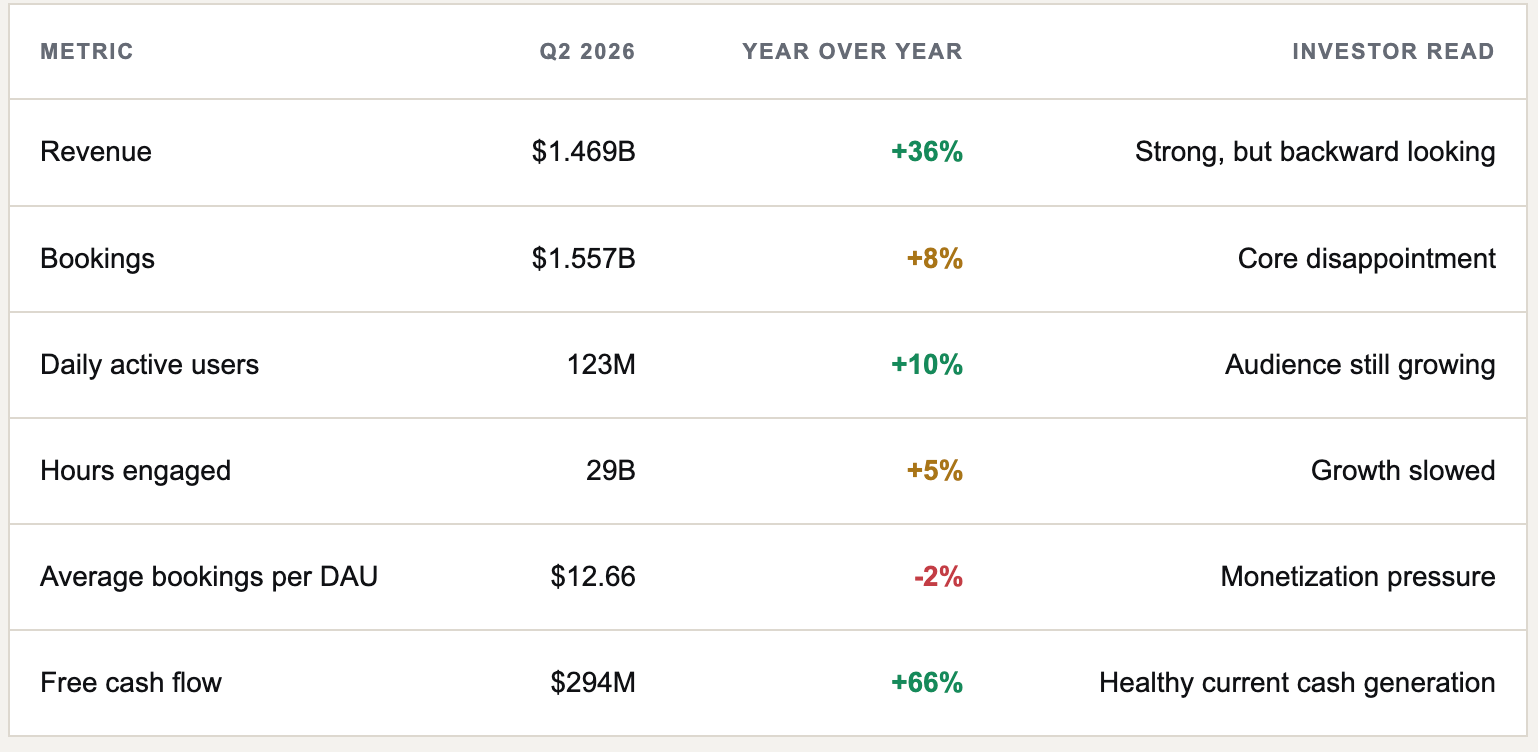
The divergence between revenue and bookings matters because it tells investors that the reported income statement is still benefiting from the platform’s earlier momentum. Current purchasing activity has slowed much more sharply than recognized revenue.
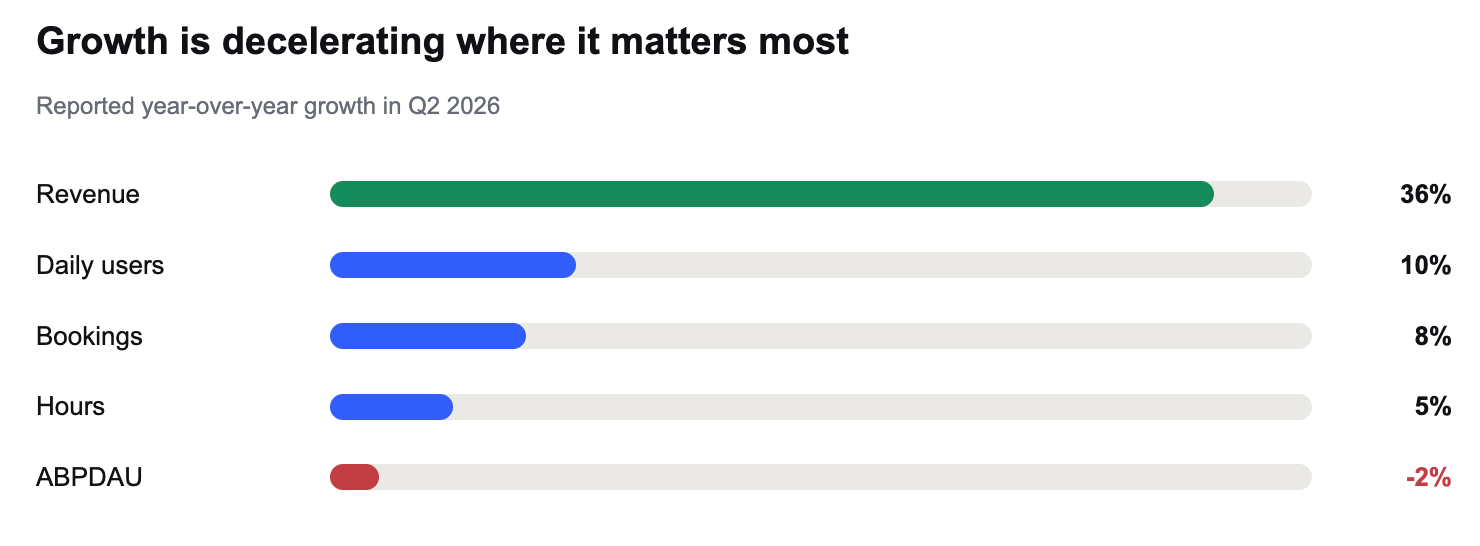
Section 2 The problem is not a user collapse. It is weaker monetization per hour.
The most important management disclosure was that bookings per hour came in below forecast, especially among users under 13. Roblox did not see a broad deterioration in retention or sign-ups. Engagement was broadly consistent with expectations. The surprise was how much less the platform earned from the engagement it generated.
There were two overlapping causes.
First, user time shifted away from the unusually powerful viral games that dominated 2025. Those games monetized at high rates and drove an exceptional bookings cycle. In Q2, engagement moved toward a broader group of new and evergreen experiences that generated less revenue per hour.
Second, Roblox changed its discovery algorithm. The recommendation system now places greater weight on long-term retention and less weight on immediate monetization. That means a game that keeps a user returning for months can receive more distribution, even if it produces fewer Robux purchases today.
2025 viral hitsHigh spending intensity and concentrated engagement
Content mix shiftMore time moves to new and evergreen games
Algorithm resetRetention receives more weight than short-term spending
Immediate impactBookings per hour and ABPDAU decline
Management thesisHigher retention eventually offsets weaker hourly monetization
This distinction is critical. A platform losing users is usually facing declining relevance. A platform growing users but earning less per hour may have a product mix problem, an algorithm problem, or a deliberate strategic tradeoff. Roblox says it is the third.
The regional data supports the idea that the pressure is concentrated in monetization rather than reach. Bookings in the United States and Canada grew only 1%, while Europe grew 18%, Asia Pacific grew 14%, and the rest of the world grew 31%. The mature North American market, which has the highest bookings per user, was the weakest part of the quarter.
Roblox still has audience growth. What it lost in Q2 was the unusually rich monetization attached to last year’s content cycle.
Section 3 Q3 guidance turns a soft quarter into a credibility test
The third-quarter outlook explains why investors reacted so violently. Roblox expects bookings of $1.576 billion to $1.653 billion, down 14% to 18% year over year. Revenue should still rise 4% to 10%, but that growth will mostly reflect the delayed recognition of prior bookings.
Cash flow is also expected to fall sharply. Operating cash flow is guided to $110 million to $175 million, compared with $546 million a year earlier. Capital expenditures are expected to reach $170 million, producing free cash flow between negative $60 million and positive $5 million.
Q3 2026 guidance versus Q3 2025
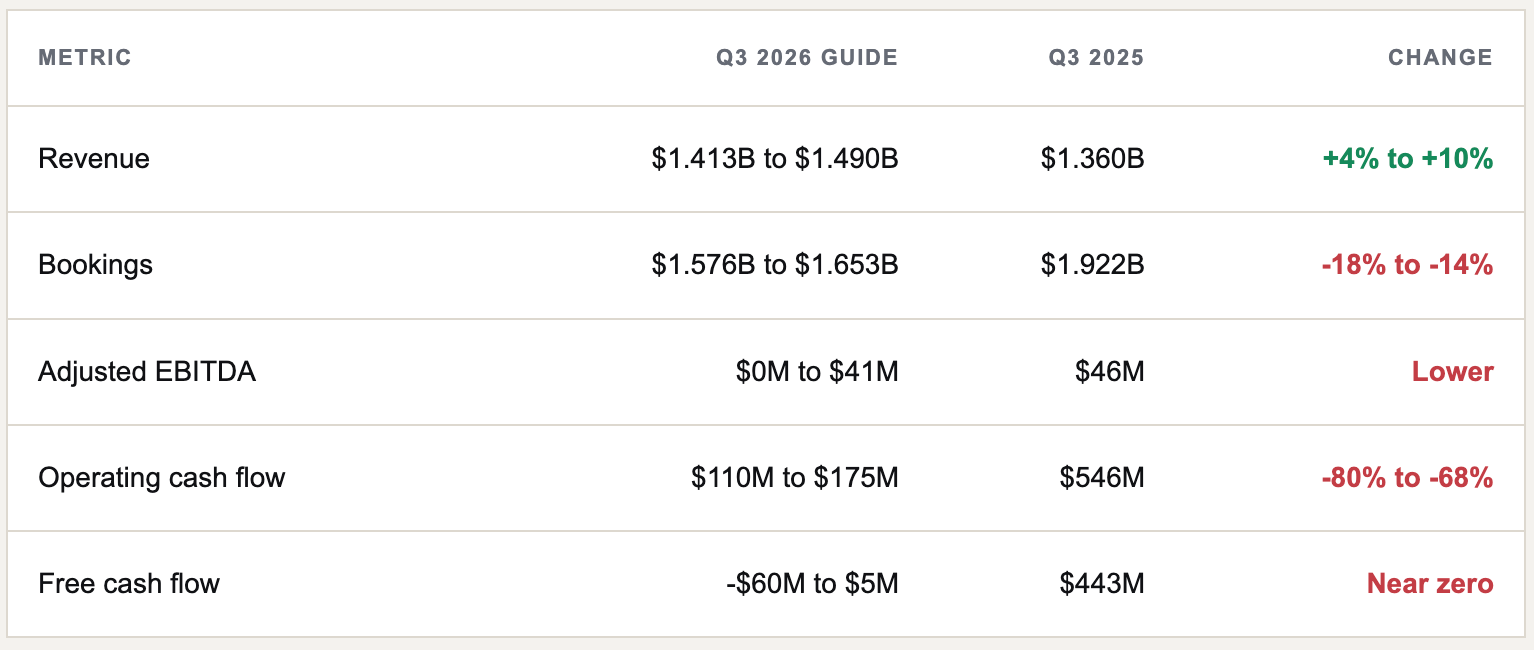
Management stopped providing full-year guidance one quarter earlier than planned, citing a wider range of full-year outcomes and its transition to quarterly-only guidance. That is a significant change from a company that entered 2026 with confidence in sustained growth.
The bull case now requires investors to trust a crossover that management can see in experiments but cannot yet quantify publicly. Roblox says improved retention eventually produces enough extra users and hours to offset the near-term drop in monetization. The company has not provided a firm timeline for that crossover.
The credibility problem: Management is asking investors to accept visible monetization damage today in exchange for a retention benefit that may appear later, while also increasing AI infrastructure spending and withholding a full-year outlook.
