
TSMC: The AI foundry prints again.

On 16 July 2026, TSMC reported second-quarter revenue of NT$1,270.4 billion (US$40.20 billion), a record, with gross margin of 67.7% that cleared the top of its own guide and net profit up 77.4% year over year. The company then did the thing the market cares about most: it raised full-year revenue growth to slightly above 40% in US dollars and lifted 2026 capital spending to US$60 to 64 billion. A clean beat, a raised outlook, and a stock that still fell on the day. This is a story about a bar that keeps moving higher than the print.
01 · The Print
A beat measured against a very high bar
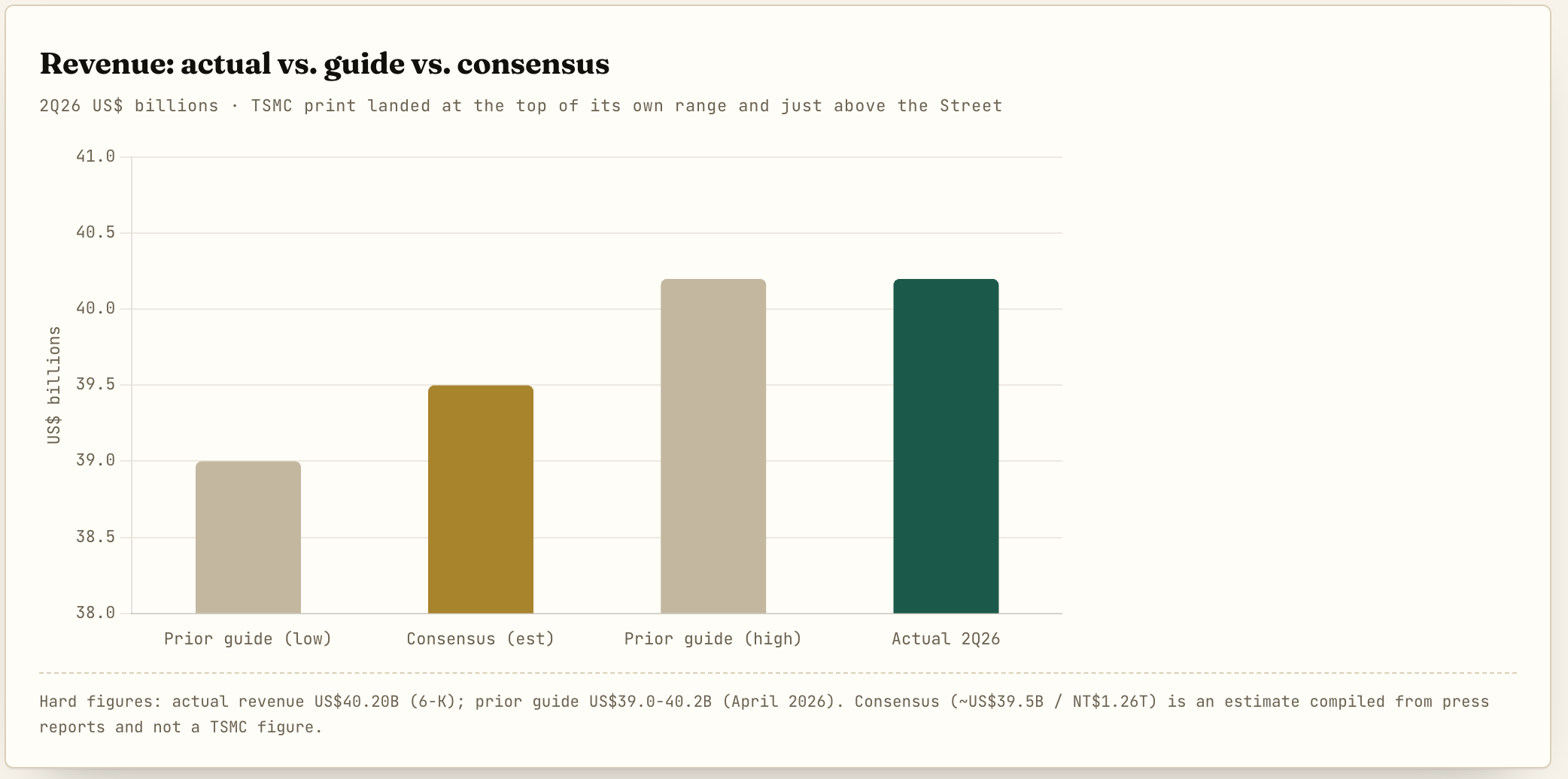
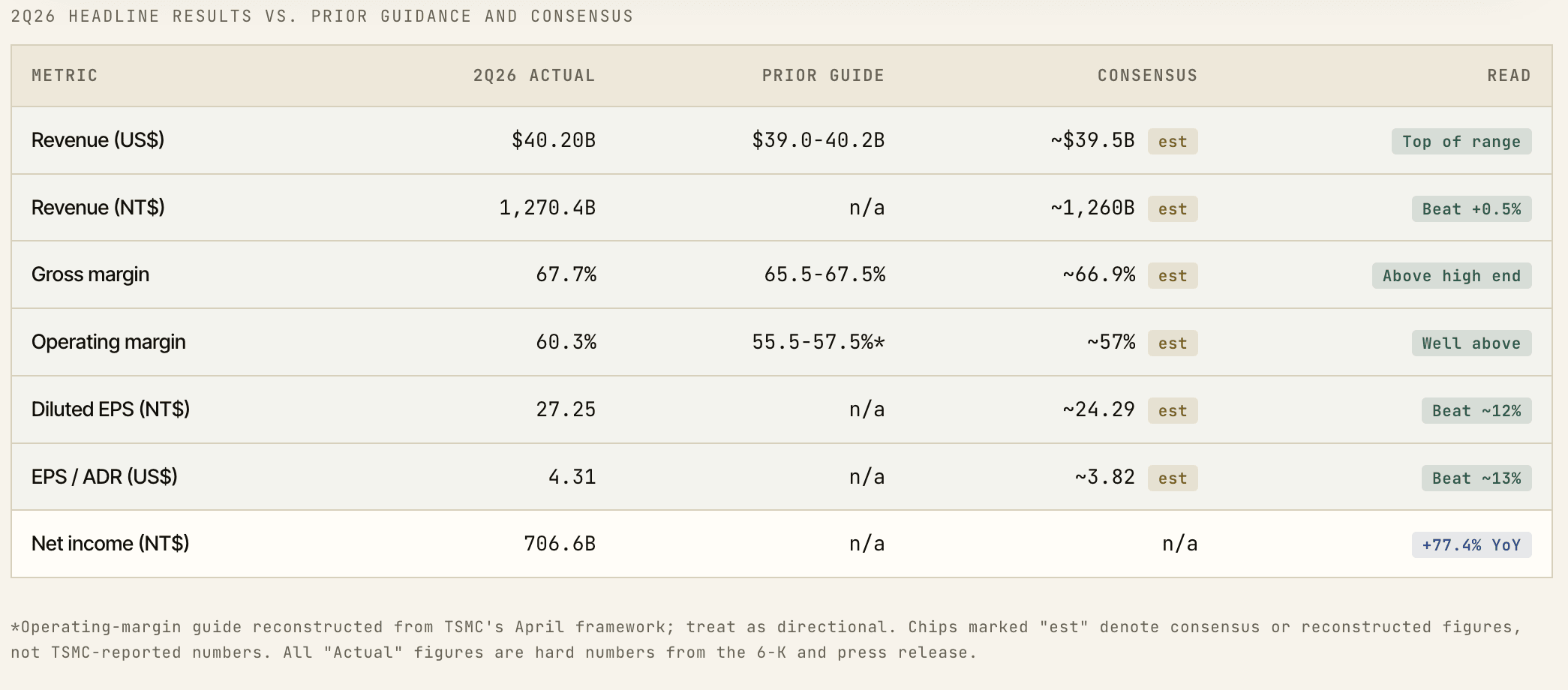
TSMC entered the quarter as the single most important company in the artificial-intelligence supply chain, and it left the quarter having removed any lingering doubt about near-term demand. Consolidated revenue was NT$1,270.38 billion, up 36.0% year over year and 12.0% sequentially. In US dollars, revenue was US$40.20 billion, landing precisely at the top of the company’s own April guidance range of US$39.0 to 40.2 billion and roughly 0.5% above the Street’s consensus of about NT$1.26 trillion consensus estimate.
The more striking line was profitability. Gross margin of 67.7% exceeded the top end of the guided 65.5 to 67.5% range and expanded about 150 basis points sequentially, despite the early, margin-dilutive ramp of 2-nanometer. Operating margin was 60.3% and net margin 55.6%. Net income of NT$706.56 billion rose 77.4% year over year and 23.4% sequentially, and diluted EPS of NT$27.25 (US$4.31 per ADR unit) beat the consensus of roughly NT$24.29 consensus estimate by a wide margin, helped by strong operating leverage and non-operating income.

Our business in the second quarter was supported by strong demand for our leading-edge process technologies.Wendell Huang, Senior VP & CFO, TSMC · 2Q26 press release
02 · Demand Mix
High Performance Computing is now two-thirds of the company
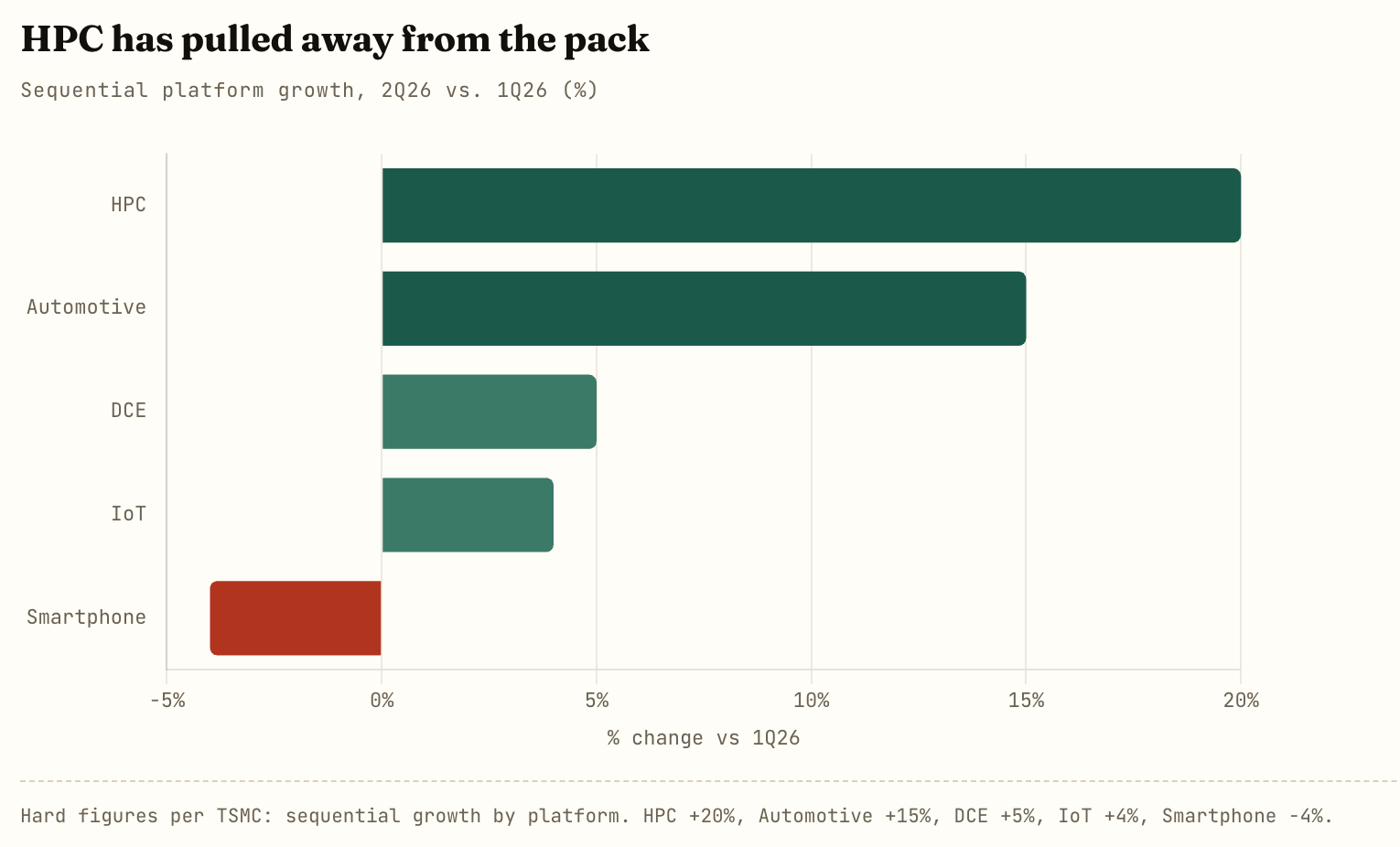
The engine is not subtle. High Performance Computing (HPC), the platform that houses AI accelerators, GPUs, and data-center CPUs, grew about 20% sequentially and reached 66% of total revenue. Smartphone slipped 4% to 22% of the mix, a seasonal and share dynamic that increasingly looks like the tail rather than the dog. IoT (5%), Automotive (4%), and DCE (1%) round out the platform picture. In one quarter, TSMC has become, functionally, an AI compute company with a large and profitable legacy attached.
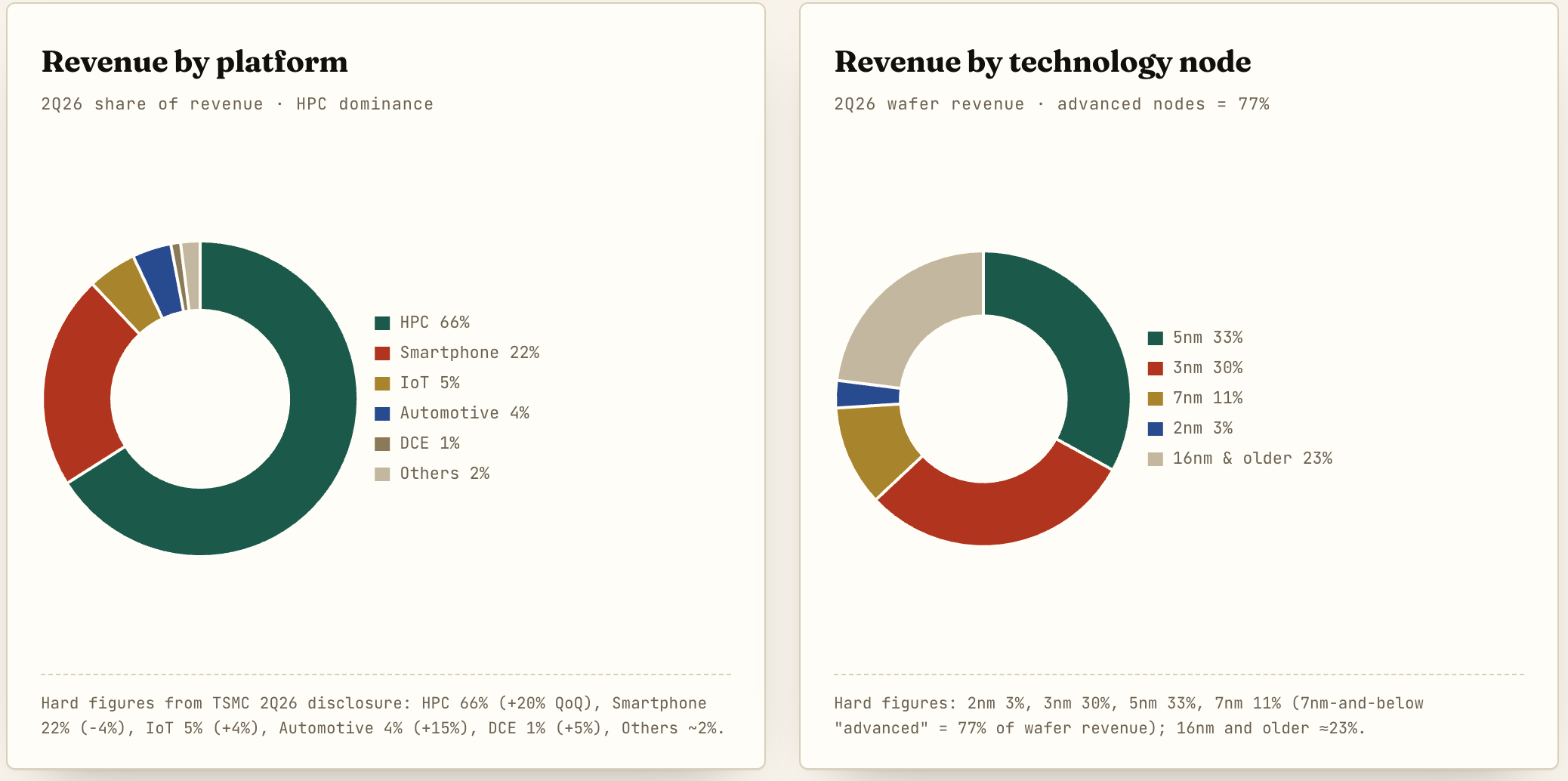
Node economics tell the same story. Advanced technologies, defined as 7-nanometer and below, were 77% of wafer revenue. The 3nm node alone contributed 30% and 5nm contributed 33%, with 2nm at 3% in its first meaningful quarter of shipments. Leading edge is where the pricing power lives, and it is where the AI accelerators, packaged with TSMC’s CoWoS advanced packaging, are manufactured. Management reiterated that CoWoS capacity remains effectively sold out through 2026, and pointed to a roadmap toward 14-reticle packaging to support ever-larger AI silicon.
The AI accelerator trajectory
Asked to quantify the AI compute growth rate, Chairman and CEO C.C. Wei declined to give a single number, but was pointed about direction: the outlook is “stronger and stronger,” and above what the company had previously communicated. Management framed agentic AI as a structural demand driver that increases compute intensity inside data centers, and signaled that CPUs, not just GPUs and XPUs, are set to reclaim a larger share of AI infrastructure spend. That breadth, across accelerators, custom silicon, and server CPUs, is the durability argument.
03 · Capex, N2 & the Global Fab Build
The bill for leadership keeps rising
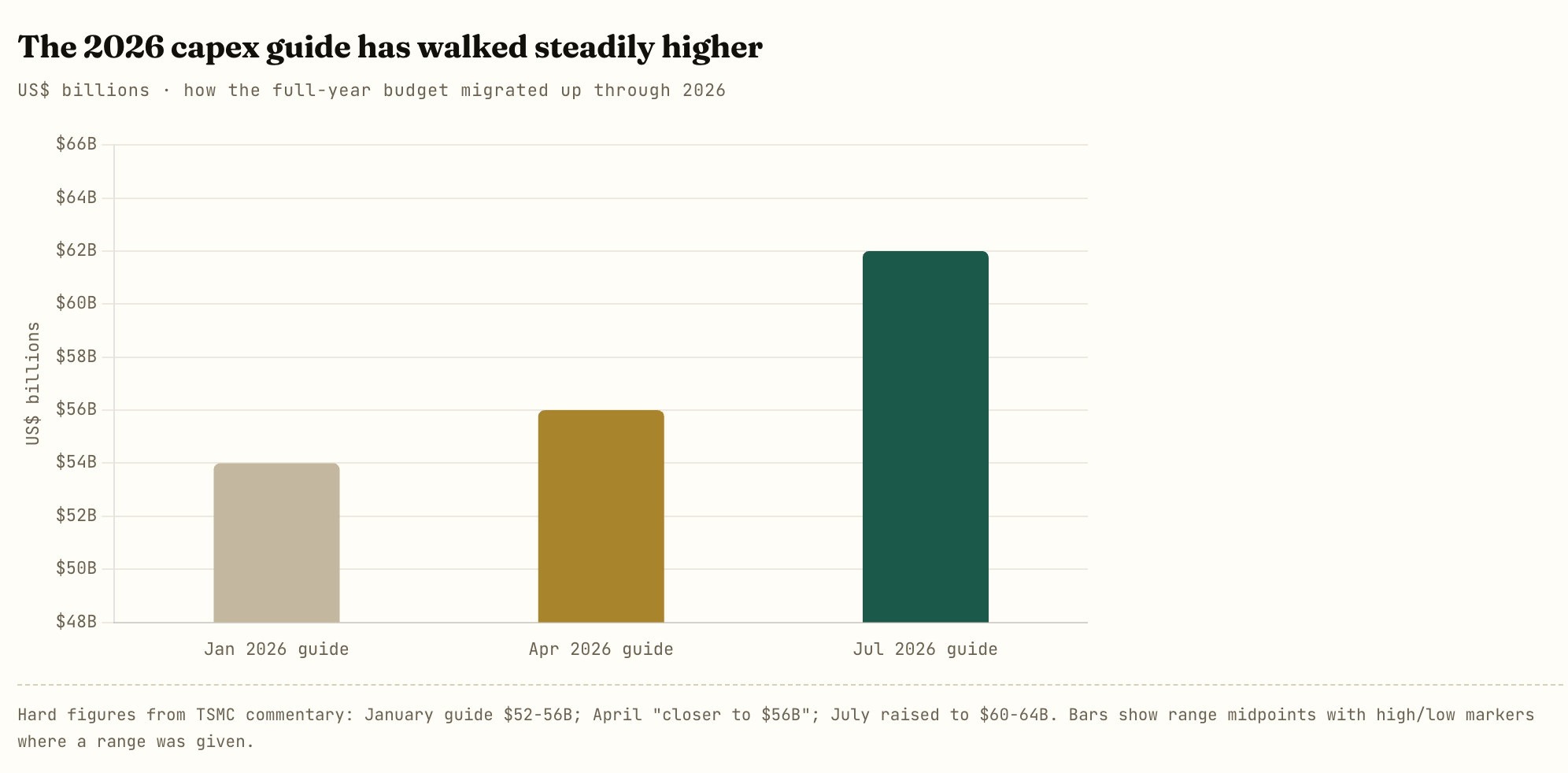
The single most debated line of the report was capital spending. TSMC raised its 2026 capital budget to US$60 to 64 billion, up from the US$52 to 56 billion guided in January and the roughly US$56 billion implied in April. Second-quarter capex alone was NT$496 billion (about US$15.7 billion). Roughly 70 to 80% of the 2026 budget goes to advanced process technologies, about 10% to specialty, and 10 to 20% to advanced packaging, testing, and mask making. CFO Huang said the company sees no bottlenecks to its expansion plans, and Wei went further on the multi-year picture: capex over the next three years will be “even more significantly higher” than the past three.
The spending is pointed at two things: the steep ramp of N2 (2-nanometer) and a widening overseas footprint. Management confirmed N2 is ramping fast (inventory days rose 7 to 87, largely on the 2nm build), and reiterated a five-year N2 revenue CAGR in the neighborhood of 70%. The next node, A14, is on track for pre-production in 2027 and volume in 2028. On the back end, CoWoS demand remains the gating item for AI accelerator shipments industry-wide.
Arizona and the margin tax of going global
TSMC used the call to flag an additional US$100 billion of US investment, funding roughly four more fabs at the 2nm node and eventually taking its Arizona-anchored American footprint toward ten fabrication plants and two packaging facilities. The strategic logic (customer proximity, tariff insulation, government incentives) is sound. The financial cost is real: management guided overseas-fab gross-margin dilution of 2 to 3 percentage points in the early years, widening to 3 to 4 points in the later stages of the build. R&D and the leading edge stay anchored in Taiwan.
The CapEx in the next three years will be even more significantly higher than the past three years.Dr. C.C. Wei, Chairman & CEO, TSMC · 2Q26 earnings call
04 · Guidance
